Latest Post


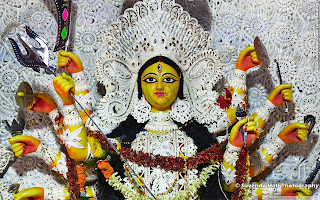
Goddess Kali Pooja In Our India
Kali Puja, also known as Shyama Puja or Mahanisha Puja, is a festival dedicated to the Hindu goddess Kali, celebrated on the new moon day of the Hindu month Kartik especially in West Bengal, Bihar, Odisha, Assam, Tripura and Bangladesh.It coincides with the pan-Indian Lakshmi Puja day of Diwali. While the Bengalis, Odias, Assamese and Maithils adore goddess Kali on this day the rest of India worships goddess Lakshmi on Diwali. Mahanisha puja is performed by the Maithili people of Mithila region in India and Nepal.

History
Artisan making an idol of goddess Kali at Kumortuli
The festival of Kali Puja is not an ancient one. Kali Puja was practically unknown before the 18th century; however, a late 17th-century devotional text Kalika mangalkavya –by Balram mentions an annual festival dedicated to Kali. It was introduced in Bengal during the 18th century, by King (Raja) Krishnachandra of Navadvipa. Kali Puja gained popularity in the 19th century, with Krishanachandra’s grandson Ishvarchandra and the Bengali elite; wealthy landowners began patronizing the festival on a grand scale. Along with Durga Puja, Kali Puja is the biggest festival in Bengal and Assam.

Worship
Kali Puja (like Durga Puja) worshippers honour the goddess Kali in their homes in the form of clay sculptures and in pandals (temporary shrines or open pavilions). She is worshipped at night with Tantric rites and mantras. She is prescribed offerings of red hibiscus flowers, animal blood in a skull, sweets, rice and lentils, fish and meat. It is prescribed that a worshipper should meditate throughout the night until dawn. Homes and pandals may also practice rites in the Brahmanical (mainstream Hindu-style, non-Tantric) tradition with ritual dressing of Kali in her form as Adya Shakti Kali and no animals are sacrificed. She is offered food and sweets made of rice, lentils and fruits. However in Tantric tradition, Animals are ritually sacrificed on Kali Puja day and offered to the goddess.A celebration of Kali Puja in Kolkata and in Guwahati is also held in a large cremation ground where she is believed to dwell.

The pandals also house images of god Shiva - the consort of Kali, Ramakrishna and Bamakhepa- two famous Bengali Kali devotees along with scenes from mythology of Kali and her various forms along with Mahavidyas, sometimes considered as the "ten Kalis." The Mahavidyas is a group of ten Tantric goddesses headed by Kali.People visit these pandals throughout the night. Kali Puja is also the time for magic shows and theatre, fireworks. Recent custom has incorporated wine consumption.

In the Kalighat Temple in Kolkata and in Kamakhya Temple in Guwahati, Kali is worshipped as Lakshmi on this day so as to reflect an essence of Vaishnava Haldars on Kali worship. Goddess Lakshmi is worshipped in her three forms, Maha Lakshmi, Maha Kali and Maha Saraswati on this day.The temple is visited by thousands of devotees who offer animal sacrifices to the goddess. Another famous temple dedicated to Kali in Kolkata is Dakshineswar Kali Temple. The famous Kali devotee Ramakrishna was a priest at this temple. The celebrations have changed little from his time.

Other celebrations
A Kali Puja pandal with a replica of the Kalighat Kali Temple icon.
A child bursting firecracker in Bengal during Kali Puja

Although the widely popular annual Kali Puja celebration, also known as the Dipanwita Kali Puja, is celebrated on the new moon day of the month of Kartika, Kali is also worshipped in other new moon days too. Two other major Kali Puja observations are Ratanti Kali Puja and Phalaharini Kali Puja. Ratanti puja is celebrated on Magha Krishna Chaturdashi and Phalaharini puja is celebrated on Jyeshta Amavashya of Bengali calendar. The Phalaharini Kali Puja is specially important in the life of the saint Ramakrishna and his wife Sarada Devi, since on this day in 1872, Ramakrishna worshipped Sarada Devi as the goddess Shodashi. In many Bengali and Assamese households, Kali is worshipped daily

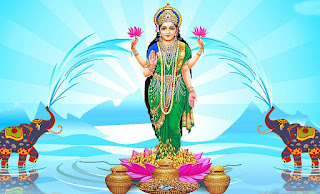

Lakshmi or Laxmi, is the Hindu goddess of wealth, fortune and prosperity.She is the wife and shakti (energy) of Vishnu, one of the principal deities of Hinduism and the Supreme Being in the Vaishnavism Tradition.With Parvati and Saraswati, she forms Tridevi, the holy trinity. Lakshmi is also an important deity in Jainism and found in Jain temples. Lakshmi has also been a goddess of abundance and fortune for Buddhists, and was represented on the oldest surviving stupas and cave temples of Buddhism. In Buddhist sects of Tibet, Nepal and southeast Asia, goddess Vasudhara mirrors the characteristics and attributes of the Hindu goddess Lakshmi with minor iconographic differences. Many people have names which means goddess Lakshmi, like Nandika, Aarna , Padmavati and Shreya.
Lakshmi is also called Sri or Thirumagal because she is endowed with six auspicious and divine qualities, or gunas, and is the divine strength of Vishnu. In Hindu religion, she was born from the churning of the primordial ocean (Samudra manthan) and she chose Vishnu as her eternal consort. When Vishnu descended on the Earth as the avatars Rama and Krishna, Lakshmi descended as his respective consort.In the ancient scriptures of India, all women are declared to be embodiments of Lakshmi. The marriage and relationship between Lakshmi and Vishnu as wife and husband is the paradigm for rituals and ceremonies for the bride and groom in Hindu weddings.Lakshmi is considered another aspect of the same supreme goddess principle in the Shaktism tradition of Hinduism.

Lakshmi is depicted in Indian art as an elegantly dressed, prosperity-showering golden-coloured woman with an owl as her vehicle, signifying the importance of economic activity in maintenance of life, her ability to move, work and prevail in confusing darkness. She typically stands or sits like a yogin on a lotus pedestal and holds lotus in her hand, a symbolism for fortune, self-knowledge and spiritual liberation. Her iconography shows her with four hands, which represent the four goals of human life considered important to the Hindu way of life: dharma, kāma, artha, and moksha. She is often depicted as part of the trinity (Tridevi) consisting of Saraswati, Lakshmi and Parvati.

Archaeological discoveries and ancient coins suggest the recognition and reverence for Lakshmi by the 1st millennium BCE. Lakshmi's iconography and statues have also been found in Hindu temples throughout southeast Asia, estimated to be from the second half of the 1st millennium CE. The festivals of Diwali and Sharad Purnima (Kojagiri Purnima) are celebrated in her honor.
Lakshmi: The Hindu Goddess Of Wealth And Beauty

ॐ महालक्ष्म्यै नमो नम: । 
ॐ विष्णुपृयायै नमो नम: ।
ॐ धनप्रदायै नमो नम : ।
 ॐ विश्वजनन्यै नमो नम: ।


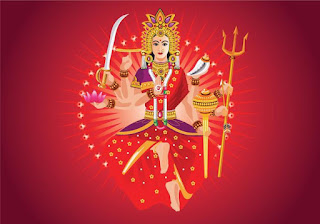
Durga Ashtami or Maha Ashtami is one of the most auspicious days of ten days long Durga Puja Festival. In India fasting is undertaken by many people on this holy occasion. This day is also known for 'Astra Puja'(Worshiping Weapons) as on this day the weapons of goddess Durga are worshiped. The day is also known as Vira Ashtami as there are seen to use arms or martial arts on this day.
Plot                                          
The eighth day of Navratri or Durga Puja celebrations is known as Durgashtami, or Durga Ashtami. It is also known as Mahashtami and is one of the most auspicious day according to Hinduism. It falls on the Ashtami tithi of Chaitra month according to the Hindu calendar.

It is believed in some regions, the Goddess Kali appeared on this day from the forehead of Mother Durga and annihilated Chanda, Munda, and Rakthabija (the demons who were associates of Mahishasura). The 64 Yoginis and Ashta Nayikas (the eight consorts of Goddess Durga) are worshiped during the Durga Puja rituals on Mahashtami. The Ashta Nayikas, also known as Eight Shaktis, are interpreted differently in different regions of India. But ultimately, all the eight goddesses are incarnations of Shakti. They are the same powerful Divine Feminine, representing different energies.

The Ashta Nayikas worshiped during Durga Puja are Brahmani, Maheswari, Kaumari, Vaishnavi, Varahi, Narasinghi, Indrani and Chamunda.
Tradition
A tradition associated with Durga Ashtami originated in North India is to honor the kanjaks in the home. A group of young, unmarried girls (a group of five or seven) are invited into the home to honor them. The tradition is based on the belief that each of these young girls( kanjaks ), represents the shakti (energy) of Durga on Earth. The group of girls are welcomed by washing their feet (a common ceremonial in India to welcome someone), welcoming them into the home, and then the rituals are done as Alati and Puja. After the rituals the girls are fed sweets and foods and honored with small gifts.

Why we celebrate Durga Ashtami


Durga Ashtami is the eight day of the Navratri and Durga Puja celebrations that take place in India every year and celebrated with religious fervour. Durga Ashtami is also known as Mahashtami and is believed to be one of the crucial days of Durga Puja. Many people observe fast for seven regular days.
Followers worship the weapons of Maa Durga on this day which is also known as Astra Puja. The day is also known as Virashtami as there are displays using arms or martial arts. It is one of the most important day for worshippers.
There is also a belief that Goddess Kali appeared from the forehead of Durga on this day to annihilate Chanda and Munda and Rakthabija. During the Durga Puja rituals on Mahashtami day the 64 Yoginis and Ashtanayikas - the eight consorts - of Durga are also worshipped.
The eight consorts of Durga, also known as Eight Shaktis, are interpreted differently in different regions of India. But ultimately all the eight goddesses are incarnations of Shakti with different aims. Sometimes they are also an attempt to give form to a particular aspect of Shakti.

The Ashtanayikas that are worshipped during Durga Puja are Brahmani, Maheswari, Kameswari, Vaishnavi, Varahi, Narasinghi, Indrani and Chamunda.

Many other minor deities including many attendants and guards of Durga are worshipped on this day.


Durga devotees observe fast on Durga Ashtami. Both men and women observe the fast. Many temples perform special pujas on the day and are visited by millions of devotees.

Durga Ashtami ends with Sandhi puja, which overlaps into the next day which is also known as Mahanavami day.


We Celebrate Durga Ashtami

Navratri--or the nine sacred days--mark the most auspicious days of the lunar calendar according to Hinduism. Celebrated with fervour and festivity all over north India, and every Hindu community the world over, these nine days are dedicated solely to Maa Durga (goddess Durga) and her nine avatars.
Why Is Navratri Celebrated
The prominent story associated with Navratri is the battle that took place between goddess Durga and the demon Mahishasura, who represents egotism. All the nine days of the festival are dedicated to each distinct avatar of the goddess; and each of these days has a significant colour attached to it, which devotees are expected to wear while taking part in the festivities. So, we've tried to break it down in easier terms for you:
The nine avatars of Durga and the colours of each avatar:
  1. Day 1: SHAILPUTRI: She is the embodiment of the collective power of Brahma, Vishnu and Mahesh. It is in this form that the goddess was worshipped as the consort of Shiva. The colour of the first day is red--it depicts action and vigour.
  2. Day 2: BRAHMCHARINI: The one who practices devout austerity. She is blissful and endows happiness, peace, prosperity and grace upon all devotees who worship her. Filled with bliss and happiness, she is the way to emancipation or moksha. The colour of the second day is royal blue, since it's synonymous with a calm-yet-powerful energy.
  3. Day 3: CHANDRAGHANTA: She represents beauty and grace and is worshipped on the third day for peace, tranquillity and prosperity in life. She is the apostle of bravery and possesses great strength. The colour of the day is yellow.
  4. Day 4: KUSHMUNDA: She is considered the creator of the universe. It is believed that Kushmunda created the universe through a bout of laughter and made it verdant with vegetation. Hence, the colour of the day is green.
  5. Day 5: SKAND MATA: She is the mother of Skanda, or Karthikeya, who was chosen by the gods as their commander-in-chief in the war against the demons. She is accompanied by Skanda in his infant form. The colour of the day is grey, as it indicates the vulnerability of a mother who can turn into a storm cloud when the need arises to protect her child.
  6. Day 6: KATYAYANI: Katyayani was born to the great sage, Kata, as an avatar of Durga. Dressed in orange, she exhibits immense courage. Hence, the colour of the day is orange.
  7. Day 7: KALRATRI: She has a dark complexion, dishevelled hair and a fearless posture. She has three eyes that shine bright, with flames emanating from her breath. She is black like the goddess Kali. She is the most fierce form of goddess Durga, and she is dressed in white, a colour that represents peace and prayer. Thus, the colour of the day is white.
  8. Day 8: MAHA GAURI: Maha Gauri is intelligent, peaceful and calm. It is said that due to her long austerities in the deep forests of the Himalayas, her colour transformed from white to back. However, later, when Shiva cleaned her with the waters of the Ganga, her body regained its beauty and she came to be known as Maha Gauri, which means extremely white. The colour of the day is pink, denoting hope and a fresh start.
  9. Day 9: SIDDHIDATRI: She has supernatural healing powers. She has four arms and is always in a happy state of mind. She blesses all gods, saints, yogis, tantriks and all devotees as a manifestation of the mother goddess. The goddess is shown to be in a blissful state, just like the sky on a clear day. Thus, the colour of the day is sky blue, representing wonderment about the beauty of nature.
Celebrated twice a year, the first Navratri that falls in the month of March or April is known as Chaitra Navratri. Most devotees of goddess Durga observe a fast for nine days, though some observe it for only two days. During the fast, one is meant to abstain from everyday grains like wheat, but can consume fruits, milk, tea, coffee, potatoes and one meal of sago food preparations--such as kuttu (singhada) atta and special rice. Instead of regular table salt, sendha (sea) salt is used for cooking.
Food eaten during Navratri:
  • * Fried or boiled potatoes
  • * Kadhi prepared with kuttu atta and sea salt
  • * Aloo tikki
  • * Banana chips
  • * Makhane ki sabzi
  • * Fruits and fruit juices
  • * Sabudana kheer
  • * Curd
  • * Lassi
  • * Kuttu atta roti with kaddu sabzi or aloo sabzi

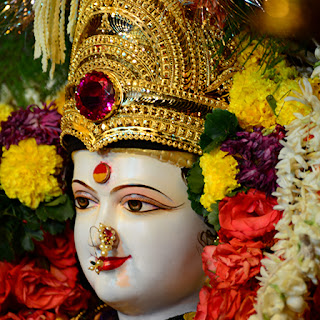
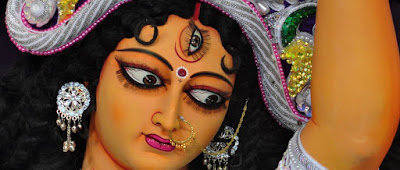
Durga Puja, also called Durgotsava, is an annual Hindu festival in the Indian subcontinent that reveres the goddess Durga.It is particularly popular in West Bengal, Bihar, Jharkhand, Odisha, Assam, Tripura, Bangladesh and the diaspora from this region, and also in Nepal where it is called Dashain. The festival is observed in the Hindu calendar month of Ashvin, typically September or October of the Gregorian calendar, and is a multi-day festival that features elaborate temple and stage decorations (pandals), scripture recitation, performance arts, revelry, and processions. It is a major festival in the Shaktism tradition of Hinduism across India and Shakta Hindu diaspora.
                                                The Important Rituals Celebrated In Durga Puja
Durga Puja festival marks the battle of goddess Durga with the shape-shifting, deceptive and powerful buffalo demon Mahishasura, and her emerging victorious. Thus, the festival epitomises the victory of good over evil, but it also is in part a harvest festival that marks the goddess as the motherly power behind all of life and creation. The Durga Puja festival dates coincide with Vijayadashami (Dussehra) observed by other traditions of Hinduism, where the Ram Lila is enacted — the victory of Rama is marked and effigies of demon Ravana are burnt instead.

The primary goddess revered during Durga Puja is Durga, but her stage and celebrations feature other major deities of Hinduism such as goddess Lakshmi (goddess of wealth, prosperity), Saraswati (goddess of knowledge and music), Ganesha (god of good beginnings) and Kartikeya (god of war). The latter two are considered to be children of Durga (Parvati). The Hindu god Shiva, as Durga's husband, is also revered during this festival. The festival begins on the first day with Mahalaya, marking Durga's advent in her battle against evil. Starting with the sixth day (Sasthi), the goddess is welcomed, festive Durga worship and celebrations begin in elaborately decorated temples and pandals hosting the statues. Lakshmi and Saraswati are revered on the following days. The festival ends of the tenth day of Vijaya Dashami, when with drum beats of music and chants, Shakta Hindu communities start a procession carrying the colorful clay statues to a river or ocean and immerse them, as a form of goodbye and her return to divine cosmos and Mount Kailash.

The festival is an old tradition of Hinduism, though it is unclear how and in which century the festival began. Surviving manuscripts from the 14th century provide guidelines for Durga puja, while historical records suggest royalty and wealthy families were sponsoring major Durga Puja public festivities since at least the 16th century.[12] The prominence of Durga Puja increased during the British Raj in its provinces of Bengal and Assam. Durga Puja is a ten-day festival, of which the last five are typically special and an annual holiday in regions such as West Bengal, Bihar, Odisha and Tripura where it is particularly popular. In the contemporary era, the importance of Durga Puja is as much as a social festival as a religious one wherever it is observed.
The Important Rituals Celebrated In Durga Puja


Hindu Temples In Maharashtra: Jeevdaani Devi


Hindu Temples In Maharashtra: Jeevdaani Devi

The legendary story of Jeevdaani Devi is as follows: During their forest journey, Pandavas came to Shurparaka. They visited the holy temple of Vimaleshwar consecrated by Lord Parashuram and on their journey to Prabhas halted on the banks of Vaitarni river. There they worshipped the Bhagavati Ekaveera on the banks of Viraar Tirtha and seeing the serenity and lofty nature decided to carve caves in the nearby mountains.

Doing so Pandavas also made a set of small caves now known as “Pandav Dongri” about a mile from Shrigaon for the hermits.Many yogis used to stay in Pandav Dongri and have darshan of Jeevdhani Devi. After the onset of Kali Yuga, and after the advent of the Buddhist faith, the number of Vaidik Yogis lessened and slowly people forget the hillock and the devi.

They did so on the hills nearby and installed and worshipped the Yoga Linga of Ekaveera devi in one of the caves. They called her Bhagavati Jeevadhani (That is Goddess, who is the real wealth of life).

During times of Jagadguru Shankaracharya’s advent, a Mahar or Mirashi used to stay in Viraar who used to graze the village cattle.

He came to Nirmal Mandir for the darshan of Jagadguru Shankaracharya Padmanabha Swami and requested His Holiness to bless him so that he could have darshan of his beloved Kuladevata. Jagadguru was pleased with the devotion of Mahar and advised him to serve Go-Mata on the foothills of Jivadhani, and at appropriate time he would have darshan of his Goddess and attain Go-Loka.

He literally for the rest of life followed the advice of Jagadguru Shankaracharya and herded the village cattle. While grazing the village cattle, he used to see a cow grazing along with, whose owner never paid him for herding her. By his virtue, he determined to find the owner of the cow. He followed the cow on the top of Jeevdhan Hill. A beautiful woman with divine features appeared. The Mahar remembered the words of Jagadguru Shankaracharya and understood that she is none other than his Kuladevi Jeevdhani, he was overjoyed and asked “Oh Mother ! I have grazed your cow, will you not pay me for her herding ?”. The Devi just smiled in delight and was on the point of putting some money in the Mahar’s hand, when he said “Do not touch me, I am Mahar.

Give me something which cannot be spoilt by touch, words, smell, figure, and ether.” Knowing this Devi asked “Lo my child , whence from you learned this unique knowledge of Varnashram Dharma and Moksha Dharma?”. To this Mahar replied, “From none other than by the Grace of Jagadguru Shankaracharya”. Bhagavati was pleased by this and said “By your virtue (Punya), see this cow which is none other than Kaamadhenu has taken your forefathers to higher abodes by her tail , crossing the Vaitarini”. Thus saying the Mahar saw the cow lept from the hill top putting her two feet prints on hill foor and other two across Vaitarini River in heavens. Now Devi told, “I confer upon you the thing which you demanded that is Moksha.”

Saying so the Mahar attained Moksha (The real Jeeva Dhana, the real wealth of Life)and the Devi was about to disappear in the cave, when a barren woman saw all this divine incident screamed “Devi Devi , Amba Amba, will you leave this barren daughter of yours without our jeevan dhan a child in my laps?”. Devi was pleased by her prayers and said “ Great indeed are you who saw all three of us. I henceforth bless you with a child.” The lady was not satisfied by this, she said “Oh Mother of the three worlds, do not just bless me , but let all barren daughters of you who pray you be conferred with the child”.

Devi was pleased at this and said “See henceforth, due to the advent of Kali Yuga , in order to maintain purity of rituals, I will stay into a hole in the niche of the cave. The barren women who offer me the beetlenuts in this hole, as is offered in my original place in Mahurgad, will be rewarded with a progeny”. Thus saying the Devi disappeared. This lady spread out the incident and thus once again the Jeevdhan hill started to be visited by the pilgrims.

What's Mahalaya?

Mahalaya is an auspicious occasion observed seven days before the Durga Puja, and it heralds the advent of Durga, the goddess of supreme power. It's a kind of invocation or invitation to the mother goddess to descend on earth--"Jago Tumi Jago". This is done through the chanting of mantras and singing devotional songs.
Since the early 1930s, Mahalaya has come to associate itself with an early morning radio program called “Mahisasura Mardini” or “The Annihilation of the Demon.” This All India Radio (AIR) program is a beautiful audio montage of recitation from the scriptural verses of “Chandi Kavya”, Bengali devotional songs, classical music and a dash of acoustic melodrama. The program has also been translated into Hindi with a similar orchestration and is broadcast at the same time for a pan-Indian audience.
This program has almost become synonymous with Mahalaya. For nearly six decades now, the whole of Bengal rises up in the chilly pre-dawn hours--4 am to be precise--on the day of Mahalayato tune into the “Mahisasura Mardini” broadcast.
Mahalaya In West Bengal

The Magic of Birendra Krishna Bhadra

One man who'll always be remembered for making Mahalaya memorable to one and all is Birendra Krishna Bhadra, the magical voice behind the “Mahisasura Mardini.” The legendary narrator recites the holy verses and tells the story of the descent of Durga to earth, in his inimitable style.
Bhadra has long passed away, but his recorded voice still forms the core of the Mahalaya program. In a sonorous, reverberating voice, Birendra Bhadra renders the Mahalaya recital for two thrilling hours, mesmerizing every household with the divine his narration, as Bengalis submerge their souls in quiet moments of prayer.

An Epic Composition

“Mahisasura Mardini” is a remarkable piece of audio drama, matchless in Indian culture. Though the theme is mythical and the mantras are Vedic, this program is a landmark composition. It's scripted by Bani Kumar and narrated by Bhadra. The enchanting music is composed by none other than the immortal Pankaj Mullick, and the songs are performed by famous singers of yesteryears, including Hemant Kumar and Arati Mukherjee.
As the recital begins, the serene morning air resonates with the long drawn-out sound of the sacred conch shell, immediately followed by a chorus of invocation, melodiously setting the stage for the recitation of the Chandi Mantra.
Mahalaya In West Bengal

The Story of “Mahisasura Mardini”

The story element is captivating. It speaks of the increasing cruelty of the demon king Mahisasura against the gods. Unable to tolerate his tyranny, the gods plead with Vishnu to annihilate the demon. The Trinity of Brahma, Vishnu and Maheswara (Shiva) come together to create a powerful female form with ten arms--Goddess Durga or 'Mahamaya', the Mother of the Universe who embodies the primeval source of all power.
The gods then bestow upon this Supreme creation their individual blessings and weapons. Armed as a warrior, the goddess rides a lion to battle with the Mahisasura. After a fierce combat, the 'Durgatinashini' is able to slay the 'Asura' king with her trident. Heaven and earth rejoice at her victory. Finally, the mantra narration ends with the refrain of mankind's supplication before this Supreme Power:
"Ya devi sarbabhuteshshu, sakti rupena sanksthita Namasteshwai Namasteshwai Namasteshwai namo namaha."

Durga Puja Is Not Complete Without The Beat Of The Dhak


About the Instrument

Dhak is one of the oldest percussion instruments of Bengal similar to two sided drums. It is made of a big wooden shell with two parchment heads or sides tightened by leather straps. It is generally played with two wooden sticks beating one side, by either resting the drum on the ground on the other head, or by hanging it from the shoulder with a strap. Other variations of this instrument are also available in different size and names (like "Dhol", "Dholok"). 
Dhak is an integral part of any worship. Its beat and the rhythm create the ambience for any Bengali puja festival . The "Dhakis", create the moods for the various moments of the puja by playing the dhak with relevant rhythm and varying speed.


History of Playing Dhak

In Bengal, dhak has been used since ancient times and is referred to in various literatures like "Mangal Kabya" written during the middle ages ("Madhyajug"). During those times, along with using it during the puja festivals, dhak was also played for different occasions like cultural functions (song, drama), public announcements by the administrators, and even during various processions. In course of time, these usages have decreased and are sometimes seen infrequently in the rural areas only. However, even in this age of glamour and light and themes, any Bengali puja festival can only be complete with the mesmerizing sound and rhythm of the quintessential dhak.

Product description

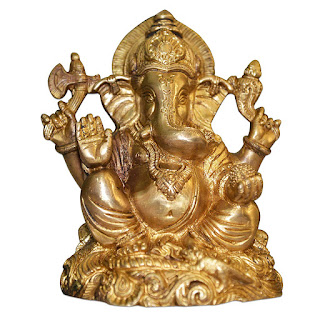
Hindu God statues and sculptures add to the well being of one's house and is also a great source of decoration. They are usually priced as per the material and craftsmanship. Some of the most popular god statues include goddess Lakshmi statue, Ram Statues, Vishnu statues, Lord Ganesha, Lord Shiva, Lord Buddha, Goddess Durga etc. Out of these Lord Ganesha's statue is one the most popular and common sculpture which could be found in almost all Hindu Homes.
Brass, a perfect union of copper and zinc, is used since 500 BC. Our exquisite collection of brass statues captures the eternal, ethereal beauty of brass in timeless pieces of art. An art form that can enhance the ornate allure of interiors be it home, office or just about any place. No tastefully done interior is complete without a brass statue or sculpture. Connoisseurs place brass artwork in all together a different bracket, defined by no other art form. These religious statues are perfect imitation of our artisans skill.
Indian artisans make various types of brass artifacts, acclaimed as much for their beauty and strength of form as their utility. Highly skilled artisans, put in their greatest devotion to render- fine quality, impeccable finish and a graceful persona to the sculptures.
DronaCraft Lord of Success Shree Ganesha Brass Statue

 Vishwakarma Puja
Vishwakarma Temple, Lohgarh, Zirakpur (Near Chandigarh)
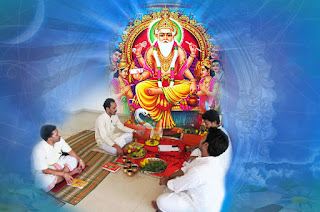
Since Vishwakarma is the divine engineer of the world, as a mark of reverence, he is not only worshiped by the engineering and architectural community but also by all professionals. It is customary for craftsmen to worship their tools in his name.

Silpy Vishwakarma is attributed a putative birthday by the Hindu religion. The more philosophical minded argue that it is impossible for the original Creator of everything to be born on a particular day. In Rig veda he is described as Swayambhu So it is a contradiction in terms since that presupposes another creator for Vishwakarma. The Vishwakarma Puja is celebrated in all parts of Nepal and India.

Even among those who believe that there is a birthday there is no agreement as to when it actually occurs. Visvakarma birthday is celebrated on two days under different names:

Vishwakarma Puja. "Vishwakarma Puja" always celebrated in India on the 17th September of every Year.
Rishi Panchami Dinam. "Rishi Panchami Dinam" literally means ‘the day of the solidarity of five rishis.’ Those who celebrate this day believe that Vishwakarma did not have a birthday like the mortals but only a commemoration day in which his five children (supposedly five rishis) came together to declare their solidarity and pray to their illustrious father. This day follows the rules of the Hindu calendar and changes with every year. The five groups among the Vishwakarma community also celebrate this as an auspicious day in commemoration of their patron god at present.
Visvakarma Jayanthi. Vishwakarma Jayanthi is celebrated by all industrial houses, artists, craftsmen, and weavers. The festival is observed on Kanya Sankranti (16 September in 2016)[23] which follows the Ganesh Puja. It was on this particular day that the forefathers of the present Visvakarma people invented the plough and gave it to humanity. The plough represents both the artisan trade as well as agriculture and therefore becomes the representative symbol of the ancient Indian civilisation. It changed the course of human history altogether. This was a change from ‘local mob culture to universal human culture’ and Vishwakarmas of India pioneered it. Coincidentally, this also becomes the birthday of Rsi/Silpi Visvakarma. So Indians in the past celebrated this day of many illustrious conjunctions as an occasion to honor Vishwakarma and his descendants.
Vishvakarman is a particular god of Hindu railwaymen in India


Ganesha Chaturthi

One of the most anticipated and lively festivals in India, Sri Ganesha Chaturthi is dedicated to the beloved elephant-headed god, Ganesha. Worshipped throughout the world wherever large Indian populations are found, the fervent devotion and colorful celebrations which attend this festival reveal just how vital Ganesha is to the spiritual heartbeat of India.

Even though each Hindu deity represents only a few aspects of the one Lord, devotees in India naturally tend to hold dearest one form more than another, for instance maybe Shiva more than Krishna, or Rama more than Kali, etc. However, all easily love and worship Lord Ganesha. He is said to be the remover of obstacles and a bringer of good fortune. Add to this His plump belly and cheerful nature, and it’s no wonder that everyone adores Him! Therefore, before any worship is offered, or beginning any undertaking whatsoever, Ganesha is propitiated. This is why His image is found in all temples and on all altars. His blessings ensure smooth sailing!
As with all of the Hindu deities, the symbolism of Ganesha is multi-layered and profound. He represents Pranava, the seed syllable OM. Just as Ganesha comes first before the other gods, OM comes at the beginning of all other mantras. The symbol for OM even resembles an elephant head! OM represents the Nada, the original substratum of Creation, from which all else arises. That substratum is identical to our essential nature, the Self. Usually depicted riding a mouse (the ego), Ganesha represents the Self in its complete conquest over egoism. He is also depicted holding an ankusha (goad), which represents His Lordship over the entire world.

There is a symbolic story {read the story} that tells of how Ganesha came by His elephant head, and received the honour of being worshipped before all of the other gods.

Traditionally held to be Ganesha’s birthday, the Chaturthi day itself falls on the 4th day of the bright fortnight of Bhadrapada* (August-September). Then it is proceded over a week of pujas, bhajans and cultural programs. A clay idol of Ganesha is made and worshipped on all of the festival days with prayers and devotional songs. The festivities culminate with the Ganesha Visarjan, where the idol is carried in a procession to the sea, river, or other large body of water, to be ceremonially immersed. The symbolism of this immersion ceremony reveals that at the heart of worship of different deities there remains the profound understanding that all forms are temporary, having both their origin and final destination in the formless Absolute.

Ganesh Chaturthi
Ganesh Chaturthi commemorates the birthday of Lord Ganesh. On this day, beautiful handcrafted idols of the Lord are installed both in homes and in public. Prana Pratishtha is performed to invoke the power of the deity into the idol, followed by a 16 step ritual known as Shodashopachara Puja. During the ritual, various offerings including sweets, coconuts, and flowers are made to the idol. The ritual should be performed at an auspicious time around midday, known as Madhyahna, when Lord Ganesh is believed to have been born.

It's important, according to tradition, not to look at the moon during certain times on Ganesh Chaturthi. If a person sees the moon, they'll be cursed with accusations of theft and dishonored by society unless they chant a certain mantra.

Apparently, this came about after Lord Krisha was falsely accused of stealing a valuable jewel. Sage Narada said that Krishna must've seen the moon on Bhadrapada Shukla Chaturthi (the occasion that Ganesh Chaturthi falls on) and was cursed because of it. Furthermore, anyone who saw the moon then would be cursed in a similar way.


The idols of Lord Ganesh are worshiped every day, with an aarti in the evening. The largest Ganesh statues, on display to the public, are usually taken out and immersed in water on Anant Chaturdasi.  However, many people who keep an idol in their homes carry out the immersion much before this.

Read More: Guide to Ganesh Visarjan (Immersion) in Mumbai

What is the Significance of Anant Chaturdasi?
You may be wondering why the immersion of Ganeshi idols concludes on this day.  Why is it special? In Sanskrit, Anant refers to eternal or infinite energy, or immortality. The day is actually devoted to the worship of Lord Anant, an incarnation of Lord Vishnu (the preserver and sustainer of life, also referred to as the supreme being). Chaturdasi means the "fourteenth". In this case, the occasion falls on the 14th day of the bright half of the moon during the month of Bhadrapada on the Hindu calendar.

Contact Form

Name

Email *

Message *

Powered by Blogger.
Javascript DisablePlease Enable Javascript To See All Widget