Latest Post


Kartika Purnima

Kartika Purnima is a Hindu, Sikh and Jain cultural festival, celebrated on the Purnima (full moon) day or the fifteenth lunar day of Kartik (November–December). It is also known as Tripuri Purnima and Tripurari Purnima. It is sometimes called Deva-Diwali or Deva-Deepawali - the festival of lights of the gods. Karthikai Deepam is a related festival celebrated in Tamil Nadu, Kerala and Sri Lanka on a different date.

Significance in Hinduism
Here, the five-headed Tripurantaka is seen pointing an arrow towards the Tripura (rightmost top corner) with the bow made of mount Meru, the serpent Vasuki is seen as its string. The four-headed god Brahma is seen. The moon and the Sun are depicted as the wheels of the chariot.
Tripuri Purnima or Tripurari Purnima derives its name from Tripurari - the foe of the demon Tripurasura. In some legends of Kartik Purnima, the term is used to denote the three demon sons of Tārakāsura. Tripurari is an epithet of god Shiva. Shiva in his form as Tripurantaka ("Killer of Tripurasura") killed Tripurasura on this day.[6] Tripurasura had conquered the whole world and defeated the gods and also created three cities in space, together called "Tripura". The killing of the demon(s) and destruction of his/their cities with a single arrow - by Shiva overjoyed the gods and they declared the day as a festival of illuminations. This day is also called "Dev-Diwali"—the Diwali of the gods. Diwali is the Hindu festival of lights.

Kartik Purnima is also the birthday of Matsya, god Vishnu's fish-incarnation (avatar). It is also the birthday of Vrinda, the personification of the Tulsi plant and of Kartikeya, the god of war and son of Shiva. This day also is considered special for Radha, the lover of Krishna - Vishnu's incarnation. It is believed that Krishna and Radha danced rasa and Krishna worshipped Radha on this day. This day is also dedicated to the pitrs, dead ancestors.

Underhill believes that the origins of this festival may lie in ancient times, when a sacrifice called Shakamedhah was performed to attain victory over enemies.

The festival has even more significance when the day falls in the nakshatra (lunar mansion) Krittika and is then called Maha Kartik. The nakshatra is Bharani, the results are stated to be special. If it is Rohini nakshatra, then the fruitful results are even much more. Any philanthropic act on this day is supposed to bring benefits and blessings equal to the performing of ten yajnas

Hindu Rituals
Kartik Purnima is closely associated with Prabodhini Ekadashi which marks the end of Chaturmas, a four-month period when Vishnu is believed to sleep. Prabodhini Ekadashi signifies the awakening of the god. Chaturmas penance ends on this day. Many fairs that begin on Prabodhini Ekadashi end on Kartik Purnima, Kartik Purnima usually being the most important day of the fair. Fairs that conclude on this day include Prabodhini Ekadashi celebrations at Pandharpur and Pushkar Fair. Kartik Purnima is also the last day to perform Tulsi Vivah ceremony that can be performed from Prabodhini Ekadashi.

Also, it is believed that Vishnu, on this day, returns to his abode after completing his stay in Bali. Hence, the day is known as Deva-Diwali.

In Pushkar, Rajasthan, the Pushkar Fair or Pushkar mela commences on Prabodhini Ekadashi and continues till Kartik Purnima, the latter being the most important. This fair is held in honour of god Brahma, whose temple stands at Pushkar. A ritual bath on Kartik Purnima in the Pushkar Lake is considered to lead one to salvation. It is believed circling the three Pushkars on Kartik Purnima is highly meritorious. Sadhus gather here and stay from ekadashi to full moon day in caves. About 200,000 people and 25,000 camels assemble in Pushkar for the fair. Pushkar fair is Asia's largest camel fair.
A ritual bath at a tirtha (a sacred water body like a lake or river) at a pilgrimage centre is prescribed on Kartik Purnima. This holy bath is known as "Kartik snana".An holy bath at Pushkar or in the Ganges river, especially at Varanasi is deemed as most auspicious. Kartik Purnima is the most popular day for bathing in the Ganges at Varanasi.The devotees also take a bath in the evening during moonrise and offer worship by way of six prayers such as Shiva sambuti, Satait and so forth.

Annakuta, an offering of food to the deities, is held in temples.People who have taken vows on Ashvin full moon day, end them on Kartik Purnima. God Vishnu is also worshipped on this day. Any form of violence (hinsa or himsa) is prohibited on this day. This includes shaving, hair-cutting, cutting of trees, plucking of fruits and flowers, cutting of crops and even, sexual union. Charity especially donation of cows, feeding of Brahmins, fasting are religious activities prescribed for Kartik Purnima. Giving gift of gold is said to fulfill all desires of people.

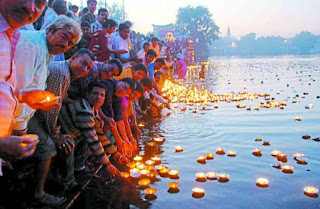
Tripuri Purnima is only next to Maha Shivaratri, amongst festivals dedicated to Shiva worship. To commemorate the killing of Tripurasura, images of Shiva are carried in procession. Temple complexes in southern India are lit up throughout the night. Deepmalas or towers of lights are illuminated in temples. People place 360 or 720 wicks in temples, to secure escape reaching hell after death. The 720 wicks symbolizes the 360 days and nights of the Hindu calendar.[9] In Varanasi, the ghats come alive with thousands of diyas (brightly lit earthen lamps). People gift lamps to priests. The lamps are kept throughout the night in houses and Shiva temples. This day is also known as "Kartik Diparatna" - the jewel of lamps in Kartik. Lights are also floated in miniature boats in rivers. Lights are placed under Tulsi, Sacred fig and Amla trees. The lights in the water and under trees are believed to help fishes, insects and birds who saw the light to attain salvation.[18]

In Tamil Nadu, Karthikai Deepam is celebrated where the Purnima corresponds to the Krittika nakshatra. People light rows of lamps on their balconys. In Tiruvannamalai, a ten-day annual festival is held to celebrate Karthikai Deepam.

In Telugu households of Andhra Pradesh, Telangana, Karthika maasalu (month) is considered very auspicious. The Kartika month starts on the day of Deepawali. From that day till the end of the month, oil lamps are lit every day. On Karthika Pournami (full moon of Kartheeka month) oil lamp with 365 wicks, prepared at home, are lit in Lord Shiva temples. Apart from that, Kartika puranam is read and fasting is observed till sunset, every day for the whole month. Swaminarayan Sampraday also celebrates this day with faith and fervor.


Palitana Jain temples
Kartik Purnima is an important religious day for Jains who celebrate it by visiting Palitana a Jain pilgrimage centre. Thousands of Jain pilgrims flock to the foothills of Shatrunjay hills of Palitana taluka on the day of Kartik Purnima to undertake the auspicious yatra (journey). Also known as the Shri Shantrunjay Teerth Yatra, this walk is an important religious event in the life of a Jain devotee, who covers 216 km of rough mountainous terrain on foot to worship at the Lord Adinath temple atop the hill.

Considered to be a very auspicious day for Jains, the day also assumes more significance for the walk, as the hills, which are closed to the public during the four months of Chaturmas, are thrown open for the devotees on Kartik Purnima. The day of Kartik Purnima is very significant in Jainism. As devotees are kept away from worshipping their lord for four months of the monsoon season, the first day attracts the maximum number of devotees. Jains believe that Adinath, the first tirthankara, sanctified the hills by visiting it to deliver his first sermon. According to Jain texts, millions of sadhus and sadhvis have attained salvation on these hills.

Sikhism
There are no auspicious days in Sikhism. Any month, day or moment a person remembers the Divine is considered auspicious. Guru Nanak was born on 1 Vaisakh, April 14, according to the (Sikh) Nanakshahi calendar. It happened to be a full-moon night.Nanakpanthi Hindus and other followers of Guru Nanak's philosophy celebrate this festival on Kartik Purnima, according to the (Hindu) Bikrami calendar. Kartik Purnima is celebrated as Gurupurab or Prakash Parva that is Guru Nanak Jayanti Worldwide.
Kartika Purnima


Tulsi Vivah
Tulsi Vivah is the ceremonial marriage of the Tulsi (holy basil) plant to the Hindu god Shaligram or Vishnu or to his avatar, Sri Krishna. The Tulsi wedding signifies the end of the monsoon and the beginning of the wedding season in Hinduism.

The ceremonial festival is performed anytime between Prabodhini Ekadashi (the eleventh or twelfth lunar day of the bright fortnight of the Hindu month of Kartik) and Kartik Poornima (the full moon of the month). The day varies regionally.
Legend

Tulsi and Vishnu
Tulsi is venerated as a goddess in Hinduism and is sometimes considered as a wife of Vishnu, with the epithet, “Vishnupriya”, “the beloved of Vishnu”. The legend behind Tulsi Vivah and its rites are told in the scripture, Padma Purana.

According to the Hindu scripture’s, the Tulsi plant was a woman named “Vrinda” (Brinda; a synonym of Tulsi). She was married to the Asura king Jalandhar, who due to her piety and devotion to Vishnu, became invincible. Even Shiva could not defeat Jalandhar, so he requested Vishnu - the preserver in the Trinity - to find a solution. Vishnu disguised himself as Jalandhar and tricked Vrinda by having intercourse with her.

Her chastity destroyed, Jalandhar lost his power and was killed by Shiva. Vrinda cursed Vishnu to become black in colour and to be separated from his wife, Lakshmi. This was later fulfilled when he was transformed into the black Shaligram stone (actually a fossil), and in his Rama avatar, was separated from his wife Sita, who was kidnapped by the asura king Ravana. Vrinda then drowned herself in the ocean, and the gods (or Vishnu himself) transferred her soul to a plant, which was henceforth called Tulsi.

As per a blessing by Vishnu to marry Vrinda in her next birth, Vishnu – in form of Shaligram - married Tulsi on Prabodhini Ekadashi. To commemorate this event, the ceremony of Tulsi Vivah is performed. Another minor legend narrates that Lakshmi slew a demon on this day and remained on earth as the Tulsi plant.
Celebrations
The marriage of Tulsi with Vishnu/Krishna resembles the traditional Hindu wedding.The marriage ceremony is conducted at homes and at temples where a fast is observed on the Tulsi Vivah day until evening when the ceremony begins. A mandap (marriage booth) is built around the courtyard of the house where the Tulsi plant is usually planted in centre of the courtyard in a brick plaster called the Tulsi vrindavana. It is believed that the soul of Vrinda resides in the plant at night and leaves in the morning.The bride Tulsi is clothed with a sari and ornaments including earrings and necklaces. A human paper face with a bindi and nose-ring may be attached to Tulsi. The groom is a brass image or picture of Vishnu or Krishna or sometimes Balarama or more frequently the Shaligram stone - the symbol of Vishnu. The image is clothed in a dhoti. Both Vishnu and Tulsi are bathed and decorated with flowers and garlands before the wedding. The couple is linked with a cotton thread (mala) in the ceremony


Tulsi plant worshipped as part of Tulsi Vivah celebrations.
At Prabhu Dham in Saunja, India, the festival is collectively celebrated by whole village which makes it a significant point of attraction. Here it is celebrated as three day festival in the hindi month of Kartik from Ekadashi to Trayodashi. The festival is started with the vedic chanting of Ramcharitmanas or Ramayana by the villagers itself. The second day is celebrated as Sobha Yatra which is of significat importance in which the special prasad is Pongal, and the third day is celebrated as Tilakotsav and Vivahotsav of Lord Vishnu and Devi Brinda. The villagers prepare 56 types of prasad known as Chapan Bhog and distributed to all. All caste takes participation in this village accordingly. Devoties including saints and mahants all over from Bihar visit this place to celebrate this festive occasion.

In Maharashtra, an important ritual in the ceremony is when the white cloth is held between the bride and the groom and the priest recites the Mangal Ashtaka mantras. These mantras formally complete the wedding. Rice mixed with vermilion is showered by the attendees on Tulsi and Vishnu at the end of the recitation of the mantras with the word "Savadhan" (literally "be careful" implying "You are united now". The white curtain is also removed. The attendees clap signifying approval to the wedding. Vishnu is offered sandalwood-paste, men's clothing and the sacred thread. The bride is offered saris, turmeric, vermilion and a wedding necklace called Mangal-sutra, worn by married women. Sweets and food cooked for an actual wedding are cooked for Tulsi Vivah too. This ceremony is mostly performed by women. The prasad of sugar-cane, coconut chips, fruits and groundnut is distributed to devotees.

The expenses of the wedding are usually borne by a daughter-less couple, who act as the parents of Tulsi in the ritual wedding. The giving away of the daughter Tulsi (kanyadaan) to Krishna is considered meritorious to the couple. The bridal offerings to Tulsi are given to a Brahmin priest or female ascetics after the ceremony.

In two Rama temples in Saurashtra, the ceremony is more elaborate. An invitation card is sent to the groom's temple by the bride's temple. On Prabodhini Ekadashi, a barat bridal procession of Lalji - an image of Vishnu - sets off to the bride's temple. Lalji is placed in a palanquin and accompanied by singing and dancing devotees. The barat is welcomed on the outskirts of Tulsi's village and the ceremonial marriage is carried at the temple. At the bride's side, Tulsi is planted in an earthen pot for the ceremony. People desirous of children perform Kanyadaan from Tulsi's side acting as her parents. Bhajans are sung throughout the night and in the morning the barat of Lalji returns to their village with Tulsi.

Prabodhini Ekadashi also known as Devotthan Ekadashi, is the 11th lunar day (ekadashi) in the bright fortnight (Shukla Paksha) of the Hindu month of Kartik. It marks the end of the four-month period of Chaturmas, when god Vishnu is believed to sleep. It is believed that Vishnu sleeps on Shayani Ekadashi and wakes on Prabodhini Ekadashi, thus giving this day the name "Prabodhini Ekadashi" ("awakening eleventh"), Vishnu-prabodhini ("awakening of Vishnu") and Dev-Prabodhini Ekadashi, Deothan, Dev uthav ekadashi or Dev Oothi ekadashi ("god's awakening"). The end of Chaturmas, when marriages are prohibited, signifies the beginning of the Hindu wedding season. It is also known as Kartiki Ekadashi, Kartik Shukla ekadashi and Kartiki. Prabodhini Ekadashi is followed by Kartik Poornima, which day is celebrated as Dev Diwali or Diwali of gods. It is also believed that Lord Vishnu married to goddess Tulsi on this Day.

Rituals
A fast is observed on Prabodhini Ekadashi and the ritual marriage of the Tulsi plant is performed with god Vishnu, in the form of the holy black colored Shaligram stone, which is regarded as the husband of Tulsi, in its twenty four permutations. During evening time people prepare floor designs by geru paste( red soil) and rice paste which is a very well known tradition. Images of Lakshmi and Vishnu are also prepared from it. Lakshmi pujan and Vishnu pujan is observed at evening time with sugarcane, rice, dried red chillies, etc. And, is then given to pandits. This ritual marriage is known as Tulsi Vivah and may be conducted on the next day of Prabodhini Ekadashi instead of Prabodhini Ekadashi itself.

Pandharpur
In Maharashtra, Prabodhini Ekadashi is linked with the god Vithoba - a form of Vishnu. Varkari pilgrims throng the Pandharpur temple of Vithoba on this day. The celebrations in Pandharpur continue for five days, till the full moon day (Kartik Poornima). On Prabodhini Ekadashi, the chief minister or a minister of Maharashtra state performs ritual components of worship on behalf of the Government of Maharashtra. This form of worship is known as sarkari-mahapuja.

In Pushkar, Rajasthan, the Pushkar Fair or Pushkar mela commences on this day and continues till the full moon day (Kartik Poornima). This fair is held in the honour of god Brahma, whose temple stands at Pushkar. A ritual bath during the five days of the fairin the Pushkar lake is considered to lead one to salvation. Sadhus gather here and stay from ekadashi to full moon day in caves. About 200,000 people and 25,000 camels assemble in Pushkar for the fair. Pushkar fair is Asia's largest camel fair.


Sugarcane harvest
Prabodhini Ekadashi also marks the beginning of sugarcane harvest. The farmer performs a puja in the field and ceremoniously cuts some sugarcane, laying some at the boundary of the field and distributing five canes to a Brahmin (priest), blacksmith, carpenter, washer-man and water-carrier and taking five canes at home. At home, figures of Vishnu and his consort Lakshmi are drawn on a wooden-board with cowdung and butter. The sugarcane are tied together at the top and placed round the board. Some cotton, betel-nut, lentils and sweets are offered along with a yagna (fire sacrifice). A prabhatiya, or song urging the god to wake, is sung. The canes are then broken and hung off the roof till Holi, when they are burnt.

Swaminarayan sect
Prabodhini Ekadashi is considered as an important Ekadashi in the Swaminarayan sect. The day commemorates the diksha, or religious initiation, of Swaminarayan by his guru Ramanand Swami on October 28, 1800.[16] The day also commemorates the passing of authority by Ramanand Swami to Swaminarayan on November 16, 1801.Swaminarayan followers observe a waterless fast and offer an offering of fresh vegetables to the deities.


JAGADHATRI PUJA


Jagadhatri Puja is a very famous puja in West Bengal and other parts of India after Durga Puja and Kali Puja. This puja was initiated by Sharda Devi, the wife of Sri Ramakrishna Paramahamsa. The two most popular names associated with this puja are Maharaja Krishna Chandra of Nadia and Indranarayan Roy Choudhury of Chandan Nagar. We have evidences to show that this puja has a long history from as early as 1713.

The other names of Jagadhatri are Maheswari, Karindrasuranisudini, Shaktacharpriya, and Adharabhuta. The Tantra sects of the Shakta school view Jagadhatri as the symbol of Shakti or Supreme Energy. She has three eyes and four arms that hold a Chakra (discus), shankha (conch), bow and arrow. Dressed in red saree, she wears magnificent jewels and Nagayajnopaveetha (a sacred thread of snake). She vanquished the elephant demon known as Karindrasura and symbolizes the victory of good over evil.

 JAGADHATRI 2018 PUJA TIMING
Jagadhatri puja is celebrated in the Bengali month of Kartik (October – November). This year, the Jagadhatri puja extends on two days from Friday, 16th November 2018, 9.40 a.m. to 17th November 2018 11.54 a.m.

 JAGADHATRI PUJA 2018 MATERIALS
Along with the regular puja materials, the most important materials needed for Jagadhatri puja are red color cloth for Devi, red color flowers, red sandal paste, vermilion, durva grass and Ganga water.
 
JAGADHATRI 2018 PUJA VIDHI
:- On the day of puja, wake up early in the morning and take bath. Wear clean clothes and clean the house. Clean the puja room and altar and gather the puja materials in one place.
:-   Set up a pedestal for seating Ma Jagadhatri. Give a holy bath to the idol of Jagadhatri and wipe it with a clean cloth. Then offer her red color clothes and decorate the idol with garlands, red color flowers and ornaments as you please.
:-  Light the lamp with ghee or oil and light incense sticks.
:-   Start the puja with Ganesh worship for removing the obstacles to the puja. Offer incense, sandal paste and nivedan to Ganesh and start the puja.

:-    Chant the mantras and names of Jagadhatri and offer red color flowers for every chanting at the feet of Ma Jagadhatri. Aslo use Dhurva grass for the puja.
:-    Offer all the special dishes made for the puja and do arati for Ma Jagadhatri.
:-   Pray for the welfare of the family and prostrate in front of the idol seeking the blessings of Ma Jagadhatri.

JAGADHATRI 2018 VRAT VIDHI
Some people observe a strict vrat on the puja day. The Prasad offered to Devi is consumed and then the devotee abstains from eating or drinking anything throughout the day. In the evening, arati is performed to Devi Jagadhatri and the fast is concluded.


JAGADHATRI 2018 VRAT VIDHI
Ma Jagadhatri is a highly compassionate form of the Supreme Reality. Jagadhatri puja can remove all the afflictions, worries and troubles and save the individuals from all harm. It can fulfill all their wishes of the devotees and give them the superior wisdom.

Chhath is an ancient Hindu Vedic festival historically native to the Indian subcontinent, more specifically, the Indian states of Bihar, Jharkhand, Odisha, Uttar Pradesh and West Bengal as well as the Madhesh region of Nepal.The Chhath Puja is dedicated to the Sun and his wives Usha and Sangya or Sandhya in order to thank them for bestowing the bounties of life on earth and to request the granting of certain wishes. Chhath does not involve any idol worship. This festival is observed by Nepalese and Indian people, along with their diaspora. While it is a Hindu festival, some Muslims also celebrate Chhath. Although the festival is observed most elaborately in Madhesh (southern) region of Nepal and Indian states of Bihar, Jharkhand and UP, it is also more prevalent in areas where migrants from those areas have a presence. It is celebrated in all Northern regions and major Northern urban centers in India. The festival is celebrated in the regions including but not exclusive to the northeast region of India, Madhya Pradesh, Bihar, Uttarkhand, Uttar Pradesh, Odisha, Chhattisgarh, Jharkhand, Rajasthan Mumbai,Mauritius, Fiji, South Africa, Trinidad and Tobago, Guyana, Suriname, Jamaica, other parts of the Caribbean, United States, United Kingdom, Republic of Ireland, Australia, New Zealand, Malaysia, Macau, Japan, and Indonesia. 

Date of the festival
Chhath puja is performed on Kartika Shukla Shashthi, which is the sixth day of the month of Kartika in the Vikram Samvat. This falls typically in the month of October or November in the Gregorian English Calendar. It is also celebrated in the month of Chaitra.

Chhath Puja 2018 Dates
Chhath puja is on the 13th(evening ) & 14th(sunrise) of November 2018. The four-day festival will start from 11 November and will end on 14 November.[citation needed]

It is also celebrated in the summer (March–April), on Chaitra Shashthi, some days after Holi; this event is called Chaiti Chhath. Chhath is an arduous observance, requiring the worshipers to fast without sip of water for around 36 hours continuously.


Etymology
The word chhath means sixth[citation needed] in Nepali, Maithili and Bhojpuri languages and the festival is celebrated on the sixth day of the month Kārtika of the Hindu luni-solar Bikram Sambat calendar. The word is a Prakrit derivation from the Sanskrit ṣaṣṭhi, meaning sixth.It is the longest and most important festival after navratri.


History
It is believed that the ritual of Chhath puja may date back to the ancient Vedic texts, as the Rigveda contains hymns worshiping the Sun god and describes similar rituals. The rituals also find reference in the Sanskrit epic poem Mahābhārata in which Draupadi is depicted as observing similar rites.

In the poem, Draupadi and the Pandavas, rulers of Indraprastha (modern Delhi), performed the Chhath ritual on the advice of noble sage Dhaumya. Through her worship of the Sun God, Draupadi was not only able to solve her immediate problems, but also helped the Pandavas later regain their lost kingdom.

Its yogic history dates back to the Vedic times. The rishis of yore used this method to remain without any external intake of food as they were able to obtain energy directly from the sun's rays. This was done through the Chhath method. Another history behind celebrating the Chhath puja is the story of Lord Rama. It is considered that Lord Rama of Ayodhya and Sita of Mithila had kept fast and offer puja to the Lord Sun in the month of Kartika in Shukla Paksh during their coronation after returning to the Ayodhya after 14 years of exile.


Chhathi Maiya
The Goddess who is worshipped during the famous Chhath Puja is known as Chhathi Maiya. Chhathi Maiya is known as Usha in the Vedas. She is believed to be the beloved younger wife of Surya, the sun god. In mithilanchal region she is also worshipped as name of "RANA MAI ".

This is the only festival which signifies both the rising and setting sun.

The most unique feature about the Chhath Puja is the main idea behind it which is above the disputed concept of Murti Pujan (Idol Worshipping) unlike most of the festivals of the Hindu religion. Some people simply believe that, Sun is necessary for life of possibly every creature on the earth and this festival is a way to pay tribute to it irrespective of caste, creed, gender and social stigmas.


Rituals and traditions
The rituals of the festival are rigorous and are observed over a period of four days. They include holy bathing, fasting and abstaining from drinking water (Vratta), standing in water for long periods of time, and offering prasad (prayer offerings) and arghya to the setting and rising sun. Some devotees also perform a prostration march as they head for the river banks. The very first day of chhath starts exactly 4 days from Diwali and last for 4 more days. This day the people who observe fast take bath at a river or pond and prepare lunch (consisting of rice, dal mixed with pumpkin, made in pure ghee).

The second day (5th day from Diwali) is known as kharna or kheer- roti or kheer-puri. In which the kheer( A Indian recipe where rice is prepared with sweetened milk instead of water) and chapati ( called roti in many Indian provinces). The people observe fast for the full day without taking even water and eat this kheer-roti as dinner after offering it to the rising moon and Goddess Ganga. This is the only time when they eat or drink anything from the starting of the day till the last day of chhath.

The third day is the main festival day (exactly 6th day from Diwali) of chhath.The devotees maintain 'nirjal vrat(vrata)' ( Fast without even taking a drop of water ) on the third day. It mainly consist of going on river bank and offering 'argha' ( offering of fruits and sweets in winnow ) and surya namaskar to the setting sun followed by the next day (exactly 7th day from Diwali) event of offering argha and surya namaskar to the rising sun on the fourth or last day of chhath. The fast then comes to an end after offering argha to rising sun. In this way, nearly 42 hours of strict penance comes to an end. The main worshipers, called Parvaitin (from Sanskrit parv, meaning 'occasion' or 'festival'), are usually women. However, a large number of men also observe this festival as Chhath is not a gender-specific festival. The parvaitin pray for the well-being of their family, and for the prosperity of their offsprings. The starting of the chhath is known as "chhath uthana" and stopping is known as "chhath baithana". Once a family member starts performing Chhath Puja, it is their compulsory duty to perform it every year and to pass it on to the following generations. The festival is skipped only if there happens to be a death of a person or birth of a child in the family that year. If the person stops performing the ritual on any particular year, it stops permanently and one cannot resume it again. Hence, once started, it cannot be stopped and once stopped, it cannot be restarted.

The prasad offerings include sweets, Kheer, Thekua, rice laddu(made of rice grit) and fruits (mainly sugarcane, sweet lime and banana) offered in small bamboo soop winnows. The food is strictly vegetarian and is cooked without salt, onions or garlic. Emphasis is put on maintaining the purity of the food. It is said that the festival and the rules must be followed strictly as it us said that it brings more adverse effects than the gain that the puja provides if any of the smallest rule is broken. It is the festival in which providing the helping hand of the person doing the puja is also considered as a good omen.


The festival of Bhai Dooj is also celebrated by the Hindus of Nepal where it is known as Bhai Tika. The occasion of Bhai Tika or Kija Puja is celebrated on the fifth day of the Tihar festival which is equivalent to the Diwali celebrations of India. Bhai Tika falls on the Dwitiya of Kartik Sukla Paksha every year according to the Vikram Samvat calendar.
Timing of Bhaiya Dooj celebration 2018
According to the Hindu mythology and astrology, timing does have an important role in the celebration of any special occasion. In order to attain the blessings of the Gods and Goddesses, people need to celebrate special days at the appropriate timings to ward off the influence of evil and negative power. This appropriate timing for the celebration of an occasion is depicted by the Panchang, the old Hindu calendar that is based on Vikram Samvat era. Here are the crucial details related to the special occasion as shown below:

Goverdhan Puja, or Annakut or Annakoot (translated as “a mountain of food”)as it is also known, is a Hindu festival in which devotees prepare and offer a large variety of vegetarian food to Bhagwan (God) Shri Krishna as a mark of gratitude.For Vaishnavas, this day commemorates the incident in the Bhagavata Puran when Bhagwan Shri Krishna lifted the Govardhan Hill to provide the villagers of Vrindavan shelter from torrential rains. The incident is seen to represent how God will protect all devotees who take singular refuge in him. Devotees offer a mountain of food, metaphorically representing the Govardhan Hill, to God as a ritual remembrance and to renew their faith in taking refuge in God.The festival is observed by most of Hindu denominations all over India and abroad. For Vaishnavas this is one of the important festivals. For the Vallabh Sampradaya (Pushtimarg), the Gaudiya Sampradaya of Chaitanya, and the Swaminarayan Sampradaya etc among others. The Annakut festival occurs on the first lunar day of Shukla Paksha (bright fortnight) in the Hindu calendar month of Kartik, which is the fourth day of Deepawali (Diwali), the Hindu festival of lights, and also the first day of the Vikram Samvat calendar. 
Krishna holding Mount Govardhan
Krishna spent most of his childhood in Braj, a place devotees associate with many of Krishna’s divine and heroic exploits with his childhood friends. One of the most significant incidents, described in the Bhagavata Purana, involves Krishna lifting Mount Govardhan (Govardhan Hill), a low hill situated in the middle of Braj.According to the Bhagavata Purana, forest-dwelling cowherds living close to Govardhan used to celebrate the autumn season by paying respect to Indra, the God of rain and storm. Krishna did not approve of this since he desired that the villagers worship Mount Govardhan with the reason that Mount Govardhan is the one that provides natural resources to the villagers for their livelihood. Trees provided oxygen, the grass provided food for the cattle and provided natural beauty. The mountain was responsible for the natural phenomena that occur in the city of Gokul. Indra got angry with this advice. Shri Krishna, though being younger than almost everyone in the city, was respected by everyone due to his knowledge and immense power. So, the people of Gokul agreed with Shri Krishna's advice. Indra was angered upon seeing the villagers' devotion diverted away from him and toward Krishna. Indra decided to initiate thunderstorms and heavy rains in the city in reflex of his egoistic anger. To protect the people from the storms, Shri Krishna lifted the Govardhan mount on his little finger and provided shelter to all the people and cattle of the city. After 7–8 days of continuous storms, seeing the people of Gokul being unaffected, Indra accepted defeat and stopped the storms. This day is therefore celebrated as a festival that paid respect to Mount Govardhan by preparing a 'giriyajna' - a "great offering of foods and delicacies to the mountain" Krishna then assumed the form of a mountain himself and accepted the villagers' offerings. . Indra, after causing torrential rains for seven days, ultimately gave up and bowed to Krishna’s superiority.This story is one of the most recognizable in the Bhagavata Purana.

Govardhan has since become a major pilgrimage site in Braj for devotees of Krishna. On the day of Annakut, devotees circumambulate the hill and offer food to the mountain—one of the oldest rituals in Braj.The circumambulation consists of an eleven-mile trek dotted along the way with several shrines, before which devotees place flowers and other offerings.

Families create an image of Giriraj Govardhan (the mountain) from cow dung, adorning it with miniature cow figures as well as grass as twigs, representing trees and greenery. In the days leading up to Annakut, fifty-six food items (chappan bhog) are typically prepared and offered in the evening. Someone from a cow-herding caste officiates the ritual, circling the hill with a cow and a bull, followed by families in the village. They partake in the sanctified food after offering the food to the hill. The festival often draws a large crowd, including the Chaube brahmins of Mathura.

Rituals Of Annakut
Annakut is celebrated on the fourth day of Diwali. The fourth day of Diwali is also the first day of the new year in the Vikram Samvat calendar. Therefore, the rituals surrounding Annakut are closely linked with the rituals of the five days of Diwali. While the first three days of Diwali are days of prayer to sanctify wealth and invite greater wealth into the devotee’s life, the annakut day is a day of offering gratitude for Krishna beneficence

Goverdhan Puja
Govardhan Puja is a principal ritual performed during Annakut. Although some texts treat Govardhan Puja and Annakut as synonymous, the Govardhan Puja is one segment of the day-long Annakut festival.

There are many variants of how Govardhan Puja is performed. One ritual is performed in which a god is (Lord Krishna)makes from cow dung in horizontal position.After, completing the structure it is decorated by earthernlamps(deepak or diya),the seenkh(a material which is same as the broom's chaff),candles and after worshiping,the structure of lord is feed by the bhaktas or worshipersand the ladies do fasts Prayers are also made to Lord Govardhan.

As described in the Bhagavata Purana , Govardhan Puja is chiefly identified with Krishna lifting the Govardhan Hill on his finger to protect those who sought his refuge from Indra’s torrential rage.


Dhanteras is on Monday, 5th November, 2018.
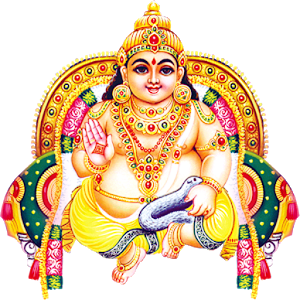
The Kubera Mantra:-
Om Yakshaya Kuberaya Vaishravanaya Dhanadhanyadhipataye  Dhanadhanyasamriddhim Me Dehi Dapaya Svaha Om Shreem Hreem Kleem Shreem Kleem Vitteshvaraya Namah Om Hreem Shreem Kreem Shreem Kuberaya Ashta-Lakshmi  Mama Grihe Dhanam Puraya Puraya Namah.

Kuber Mantra And Meaning Of Dhanteras Puja
Significance Of The Kuber Mantra :-
The Kuber mantra is said to be a powerful weapon to invoke Lord Kuber. It is said that whoever chants the Kuber Mantra 108 times regularly for three months, Lord Kuber showers his blessings on them. The Kuber mantra should be chanted early in the morning after taking a bath, in front of the Lord's image. Regular chanting of this mantra is said to bring wealth into the house and it also helps keep all the evil away. On the day of the Dhanteras, the women of the house should be dressed in new clothes, preferably in red or yellow colour.A rangoli should be made near the entrance of the house. Make a foot-print of Goddess Lakshmi with a paste of rice, in the direction of the entrance of the house. Light a diya in front of the goddess and perform aarti. Make sure to light a total of 14 diyas around the house. Including the Kuber mantra in the Dhanteras pooja aarti is said to be extremely beneficial. You can either worship the Lord's statue or even a Jewellery box or a Safe, which represents the Lord. If it is a box you are worshipping, adore it with a swastika sign and sindoor before proceeding with the pooja. Start meditating and chanting the Kuber mantra. Offer rice and flowers to the idol/box while chanting. Light incense sticks. This pooja will definitely please Lord Kuber and he will bless you and your entire family with abundance of wealth throughout.Have a Happy and Wealthy Dhanteras!

Story of Dhanteras

According to ancient legends, the celebration of Dhanteras is attributed to the story of the sixteen year old son of king Hima. Predictions were made that he would die of a snake bite on the fourth day of his marriage.
Four days hence his marriage, his newly wedded wife, being aware of this prediction laid out all her ornaments along with coins made of precious metals of gold and silver in a heap at the entrance of her husband's sleeping chamber and furbished the whole place with lamps.
Then, all night long she narrated stories and sang songs to keep her husband from falling asleep. It is believed, that when Yama, the God of death, arrived under the guise of a snake, he found himself unable to enter the prince's chamber as he was dazzled and blinded by the light of the lamps and jewellery, and so he climbed the heap of ornaments and coins and listened to the melodious songs of the wife.
In the morning, he quietly went away sparing the life of the prince. In this manner, the young wife saved her husband from the clasp of death itself. Hence, this day also came to be known as 'Yamadeepdaan'.

Another popular legend also associates itself with this festival. It believes in the appearance of Dhanvantari (physician of the Gods and an incarnation of Vishnu), with a jar of elixir on the day of Dhanteras during the cosmic battle fought between the gods and demons, who had churned the ocean for Amrita or nectar.

Dhanteras Celebration
The Dhanteras festival is celebrated with great zeal and joy. On this festival, people worship the Goddess of wealth and God of death, Lord Yama for receiving blessings in the form of good health and prosperity. People decorate their houses and offices.

Colorful, traditional rangolis adorn the entrance of all such premises; this is done to welcome the goddess of wealth and prosperity into our homes and work places. Small footprints are drawn out with rice flour and vermilion powder to indicate the long-awaited arrival of Goddess Lakshmi.

Buying new utensils or coins made of precious metals such as gold or silver on Dhanteras has become very popular as it is considered auspicious and considered to bring good luck.

Dhanteras Puja
Dhanteras is marked with the performance of 'Lakshmi Puja' in the evenings. People sing devotional songs in praise of goddess Lakshmi. They light up tiny diyas to drive all evil spirits away. On the night of Dhanteras, people light the lamps for entire length of the night. Traditional sweets are cooked and offered to the goddess.

Dhanteras is celebrated differently, in different parts of India. This is a very important festival for the mercantile community of western India. In the state of Maharashtra, people follow the custom of lightly pounding dry coriander seeds with jaggery and offering it as 'Naivedya'. In rural areas, farmers adorn and worship their cattle, as they act as their main source of income. In south India, people consider cows as incarnations of goddess Lakshmi, and hence treat them with them particular reverence.


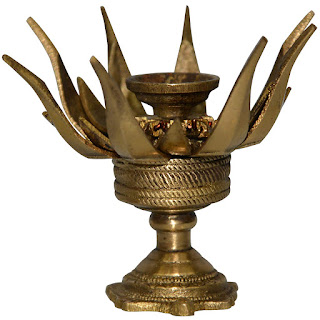
Home décor brass candle holder is made in fully arted with good finishing hand work.
Brass, a perfect union of copper and zinc, is used since 500 BC. Our exquisite collection of brass statues captures the eternal, ethereal beauty of brass in timeless pieces of art. An art form that can enhance the ornate allure of interiors be it home, office or just about any place. No tastefully done interior is complete without a brass statue or sculpture. Connoisseurs place brass artwork in all together a different bracket, defined by no other art form. These religious statues are perfect imitation of our artisans skill.
DronaCraft Home Decor Small Brass Candle Holder
Indian artisans make various types of brass artifacts, acclaimed as much for their beauty and strength of form as their utility. Highly skilled artisans, put in their greatest devotion to render- fine quality, impeccable finish and a graceful persona to the sculptures.
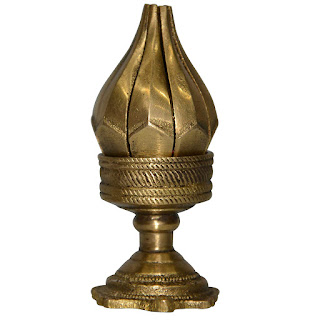
DronaCraft Home Decor Small Brass Candle Holder

DronaCraft Home Decor Small Brass Candle Holder

Diwali, Deepavali or Dipavali is the Hindu festival of lights, which is celebrated every autumn in the northern hemisphere (spring in southern hemisphere).One of the most popular festivals of Hinduism, Diwali symbolises the spiritual "victory of light over darkness, good over evil and knowledge over ignorance".During the celebration, temples, homes, shops and office buildings are brightly illuminated.The preparations, and rituals, for the festival typically last five days, with the climax occurring on the third day coinciding with the darkest night of the Hindu Lunisolar month Kartika. In the Gregorian calendar, the festival generally falls between mid-October and mid-November.

In the lead up to Diwali, celebrants will prepare by cleaning, renovating and decorating their homes and offices. During the climax, revellers adorn themselves in their finest clothes, illuminate the interior and exterior of their homes with diyas (lamps and candles), offer puja (prayers) to Lakshmi – the goddess of prosperity and wealth, light fireworks, partake in family feasts, where mithai (sweets) and gifts are shared. Diwali is also a major cultural event for the Hindu and Jain diaspora from the Indian subcontinent.
The five day festival originated in the Indian subcontinent and is mentioned in early Sanskrit texts. The names of the festive days of Diwali, as well as the rituals, vary by region. Diwali is usually celebrated eighteen days after the Dussehra festival with Dhanteras, or the regional equivalent, marking the first day of the festival when celebrants prepare by cleaning their homes and laying floor decorations, such as rangoli. The second day is Choti Diwali, or equivalent in north India, while for Hindus in the south of India it is Diwali proper. Western, central, eastern and northern Indian communities observe Diwali on the third day and the darkest night of the traditional month. In some parts of India, the day after Diwali is marked with the Goverdhan Puja and Diwali Padva, which is dedicated to the relationship between wife and husband. Some Hindu communities mark the last day as Bhai Dooj, which is dedicated to the bond between sister and brother, while other Hindu and Sikh craftsmen communities mark this day as Vishwakarma Puja and observe it by performing maintenance in their work spaces and offering prayers.

Some other faiths in India also celebrate their respective festivals alongside Diwali. The Jains observe their own Diwali, which marks the final liberation of Mahavira, the Sikhs celebrate Bandi Chhor Divas to mark the release of Guru Hargobind from a Mughal Empire prison, while Newar Buddhists, unlike other Buddhists, celebrate Diwali by worshiping Lakshmi.The festival of Diwali is an official holiday in Fiji, Guyana, India, Malaysia (except Sarawak), Mauritius, Myanmar,Nepal, Singapore, Sri Lanka, Suriname, and Trinidad and Tobago.

INDIAN MUSIC INSTRUMENTS VEENA
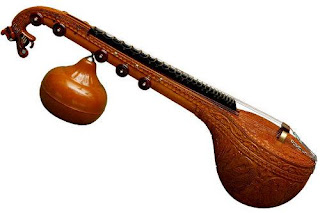
The veena comprises a family of chordophone instruments of the Indian subcontinent. Ancient musical instruments evolved into many variations, such as lutes, zithers and arched harps.The many regional designs have different names such as the Rudra veena, the Saraswati veena, the Vichitra veena and others.

The North Indian design, that has been used in classical Hindustani music, is a stick zither. About 3.5 to 4 feet (1 to 1.2 meters) long to fit the measurements of the musician, it has a hollow body and two large resonating gourds under each end.[6] It has four main strings which are melody type, and three auxiliary drone strings. To play, the musician plucks the melody strings downward with a plectrum worn on the first and second fingers, while the drone strings are strummed with the little finger of the playing hand. The musician stops the resonating strings, when so desired, with the fingers of the free hand. In modern times the veena has been generally replaced with the sitar in north Indian performances.

The South Indian veena design, used in classical Carnatic music, is a lute. It is a long-necked, pear-shaped lute, but instead of the lower gourd of the north Indian design it has a pear shaped wooden piece. It too, however, has 24 frets, four melody strings, three drone strings, and played quite similar. It remains an important and popular string instrument in classical Carnatic music.

As a fretted, plucked lute, the veena strings can produce pitches in full three octave range.The long hollow neck design of these Indian instruments allow portamento effects and legato ornaments found in Indian ragas. It has been a popular instrument in Indian classical music, and one revered in the Indian culture by its inclusion in the iconography of Saraswati, the Hindu goddess of arts and learning. These continue to be used, albeit with different designs, in Carnatic classical music and Hindustani classical music.

Etymology and history
The Sanskrit word veena  in ancient and medieval Indian literature is a generic term for plucked string musical instruments. Veena is mentioned in the Rigveda, Samaveda and other Vedic literature such as the Shatapatha Brahmana and Taittiriya Samhita. In the ancient texts, Narada is credited with inventing the veena, and is described as a seven string instrument with frets.According to Suneera Kasliwal, a professor of Music, in the ancient texts such as the Rigveda and Atharvaveda (both pre-1000 BCE), as well as the Upanishads (c. 800–300 BCE), a string musical instrument is called Vana, a term that evolved to become Veena. The early Sanskrit texts call any stringed instrument as Vana, and these include bowed, plucked, one string, many strings, fretted, non-fretted, zither, lute or harp lyre style string instrument.

The Natya Shastra by Bharata Muni, the oldest surviving ancient Hindu text on classical music and performance arts, discusses Veena. This Sanskrit text, probably complete between 200 BCE and 200 CE, begins its discussion by stating that "the human throat is a sareer veena, or a body's musical string instrument" when it is perfected, and that the source of gandharva music is such a throat, a string instrument and flute. The same metaphor of human voice organ being a form of veena, is also found in more ancient texts of Hinduism, such as in verse 3.2.5 of the Aitareya Aranyaka, verse 8.9 of the Shankhayana Aranyaka and others. The ancient epic Mahabharata describes sage Narada as a Vedic sage famed as a "vina player".


The Hindu goddess Saraswati with veena instrument. The oldest known Saraswati-like relief carvings are from Buddhist archaeological sites dated to 200 BCE, where she holds a harp-style veena.
The Natya Shastra describes a seven string instrument and other string instruments in thirty five verses, and then explains how the instrument should be played.The technique of performance suggests that the veena in Bharata Muni's time was quite different than the zither or the lute that became popular after Natya Shastra was complete. The ancient veena, according to Allyn Miner and other scholars, was closer to a harp. The earliest lute and zither style veena playing musicians are evidenced in Hindu and Buddhist cave temple reliefs in the early centuries of the common era. Similarly, Indian sculptures from the mid 1st millennium CE depict musicians playing string instruments. By about the 6th century CE, the goddess Saraswati sculptures are predominantly with veena of the zither-style, similar to modern styles.

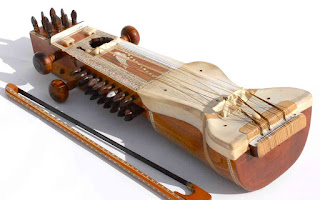
RAJASTHANI MUSICAL INSTRUMENTS SARANGI
Bowing instruments have a very rich and old tradition in India. In folk and tribal music, various types of bowed instruments are found in different regions. Some of them come close to the classical sarangi as far as shape, making and playing techniques are concerned, thus giving clear-cut evidence that the classical sarangi has been developed from these folk instruments.The sarangi, not only in Hindustani classical music, but also in folk music, is the only instrument which comes in closest proximity to the human voice. Many forms of this are in vogue in different regions of our country, but ironically, its place and time of origin have not been established as yet.
The sarangi is the only instrument which can produce almost all the nuances of vocal music of any style, be it dhrupad, khayal, thumri, tappa or bhajan or even ghazal, with exact embellishments and intonations. That is why this Instrument has always remained in close association with vocal music, and has always been preferred by vocalists as an able accompaniment. Sarangi players have always been trained in classical music to the extent that some of them have been the ustads of famous vocalists. Some of the most famous vocalists of our times were initially trained in playing sarangi and later on took to vocal music. For example, Abdul Karim Khan, Bade Ghulam Ali Khan and Amir Khan, all distinguished vocalists, originally belonged to the group of sarangi players.

Though the sarangi has all the characters of a good instrument, and is very rich in its tonal texture and techniques, it could not attain its due place in classical music. One of the reasons why it could not acquire a respectable place among other classical instruments was because of its association with dancing and singing girls of the lower castes. Here the main attraction of the performance used to be the dancer or the singer, and the sarangi player, no matter how accomplished a musician he was, always remained in the background. Later, when it (sarangi) entered the classical music and started accompanying khayal style of singing, the situation still remained the same. Although the expectations from a sarangi player were very high, his remuneration and social status always remained low.

In the latter half of the nineteenth century and the early twentieth century, harmonium (a keyboard instrument) and violin emerged as an alternatives to sarangi. These instruments were easier to handle. The sarangi and the sarangi players slowly became an endangered species. From the beginning of the twentieth century, efforts have been made by many sarangi stalwarts to perform solo on this instrument.

Sarangi in catalogue
Usually the whole length of the sarangi varies between 2ft to 2,25 ft, width 6 inch, height 4.2 inch. It weighs approximately 2 kg. It is hollowed out, chiselled and carved from a solid piece of wood. Usually tun wood is preferred to make a sarangi, but teak or mango wood is also used. The wood is well seasoned (at least for one year) before fashioning it into a sarangi. The belly (pet or pasli) is hollowed out in the front, whereas the neck (chhati) and the head (magaz) are hollowed out from the back. Thus three main portions of the instrument may be distinguished: the body (resonator), neck and peg box.
The shape of the body of the sarangi is irregular, with the waist deeper on the left side than on the right. The sound box or the pet is covered with young goat skin, tightly glued along the rim. The main ghurach or the bridge is placed in the middle of the parchment, and is supported by a leather belt (tasma), nailed to the sides of the belly. Inserted in the chhati on the right side are three rows of small pegs (khunti) made of shisham wood for sympathetic strings. The two back rows of fifteen pegs for tuning the main set of sympathetic strings are tied diagonally on the neck under the three main strings. The front row of nine pegs turies the right hand set of sympathetic strings, which run almost vertically down the right side of the neck. The resonance strings attached to the eleven front row pegs mounted on the upper peg box pass through holes in the targahan (upper nut), and are stretched over two small ghurach (bridges) called aankh or tabij. Mostly tarab strings are made of steel, but for lower pitched strings copper wire is preferred.

The playing strings are made of gut. The usual material used for these main strings is the goat's intestine. These strings are made in various places but mostly artists get them from Agra. Several guts, i.e. five, six, or even more, are wound together to make one thick string. The first string called sur, tip or jil, the middle string pancham and the third the lowest kharaj. These are tuned in S PS respectively and are of different thickness. While accompanying the female vocalist, middle string is tuned in M.

The peg box has two hollow sections. The upper box has eleven small pegs for the sympathetic strings, whereas the lower section has four larger pegs, three of which are for the main playing strings made of gut and the fourth for a thick metal sympathetic string.

The sarangi has three bridges and two aad or nuts, one for the upper tarabs and the other for the main playing strings also called pilak. Out of three bridges two flat small ghurach (called ankh or tabij) are for sympathetic strings and one for main strings. All these were made of either ivory, stag hörn or ebony. Nowadays, due to the non-availability of ivory or stag hörn, components made of even plastic are used by some makers. The main bridge is mostly designed in the shape of an elephant through which all the strings pass. The three main playing strings pass over the bridge, whereas the sympathetic strings pass through small holes drilled into the bridge like the sarod. These holes are drilled at two levels; the lower row accommodates twenty-five sympathetic strings, whereas the upper row accommodates five strings on the left and six on the right.

The sarangi gaj (bow) is curved and is at quite a distance from the hair in comparison to the violin's bow. The stick in the past was usually made from ebony which is very hard and heavy. But nowadays shisham is preferred for making bows as artists want a lighter bow. The horse tail hair is about twenty-two inches long, which is variable. The nut is fixed in position by a strong. thread, tied in a crisscross fashion.

Rosin must be applied to the hair and a piece thereof is always kept at hand. A tuning handle, called chabi, made of wood and about four-and-a-half inches long, is used to tighten or loosen the tuning pegs of sympathetic strings.

The tuning of the sympathetic strings is done in the following manner: the upper eleven tarab strings are tuned to the main raga to be played, the fifteen left side tarabs are tuned to kramik thaat (chromatic scale), the rest of the nine tarabs are tuned to the main swaras, i.e. the important notes of the raga to be played, such as vadi, samvadi and so on, according to the player's choice. The pitch of the sarangi is C sharp Kali-ek, but while playing solos, artists prefer a tuning in F or F sharp.

While playing, the artist sits cross-legged on the floor and keeps the Instrument in front of the ehest. Bowing is very important and Synchronisation of bowing with left-hand technique is a most difficult art.Mostly three fingers of the left hand are used in a unique way, and unlike other bowed Instruments, the sound is produced by the contact of string and the root of left hand finger nails, instead of the finger tips, which is a usual practice with most other bowed Instruments.

Contact Form

Name

Email *

Message *

Powered by Blogger.
Javascript DisablePlease Enable Javascript To See All Widget