Latest Post

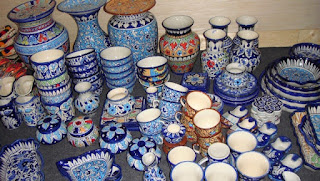
Now a languishing craft, this blue pottery is made only by a single family who can trace their lineage back to the Mughals. Blue pottery, characterised by an unusual turquoise aqua blue colour, had very limited centres for production with Delhi as one of the three main centres. The Mughals are said to be the forefathers of this artform after which the craft is supposed to have travelled from Delhi to Jaipur along with the Muslim karigars. They migrated in large numbers, attracted by Raja Man Singh, a great patron of the crafts. Legend has it that blue-pottery items were used by the Mughal kings to test their food as theycould tell by the change in glaze of the pottery that the food had, in all probability, been tampered with or poisoned.
Blue Pottery
The blue colour is obtained from cobalt oxide and is cast in a mould and glazed. A mixture of quartz, glass, borax, and katira gum sieved through a fine mesh is used to make the body of the object by blending the mixture with water to make a dough which is then cast in moulds. The moulded pieces are then dried and smoothened with sand paper. A thin solution of glass and flintstone mixed with water and wheat is applied on the semi-finished piece and then the desired areas are painted with different pigments. A second coat of glaze, made from a mixture of borax, red lead, and powdered glass is applied, along with wheat flour. The decorated and glazed wares are fired in a kiln at temperatures below 1,000 degrees celsius.

Embroidery from the Saurashtra and Kutch regions in Gujarat is not only famous but also versatile. There are plenty of stitches used to beautify the product. Abhala is the embroidery where small round pieces of mirrors are fixed on to the fabric using buttonhole stitching";" the embroidery is done in a herringbone stitch using silken thread. Rust, light green, indigo, blue, deep red, pink, and purple are the colours used. skirts, kurtis(ladies shirt) and richly embroidered blouses are the other famous items by the craftspersons.
Kathi is the oldest embroidery which is known for its romantic motifs. Geometrical motifs are fabricated with multicolored fabric pieces leading to patch work effect. Varieties of items are prepared. Heer is an embossed stitch having shades of off-white, yellow, madder red, black, indigo, ivory, and green. Small mirror pieces are used to add more beauty to the embroidery.

Ari embroidery with silk threads using a hook is a popular craft of Kutch. The motifs found commonly are, dancing peacocks, human figures in dancing poses. A Bandhani pattern complimented with beautiful and delicate bead work is an art to be praised. The various communities in Gujarat --- rabaris , , ahirs, , jats, bharwads bharwads and harijans have their own styles of embroidery. Cotton and quality silks are used by jats and mutuwas to decorate women's outfits. The embroidery of the Rabari community is usually done on a maroon background with the enclosed motifs.
Embroidery of Gujarat

Karimnagar in Andhra Pradesh has highly skilled artists practicing the delicate craftsmanship of filigree. Spoons, buttons cigarette cases, boxes, ashtrays, buttons pill boxes, jewelry, paandans and perfume containers. Designs of Peacock, parrots and fish are depicted in the perfume containers. The artisans display mastery is twisting the delicate silver wire into delicate loops knitted in a zigzag pattern resulting in an intricate lace like appearance.
This is an ancient art of metal work practiced in the traditional way. Silver filigree has Cuttack as a centre. The Silver filigree craft is locally known as Tarkashi in Orissa. . The artifacts are made of alloy which contains over 90% of silver and to compete with the changing times new methods are being used..The artists have maintained the craft by keeping themselves updated with the market requirement . Platinum polish is also used and it leaves glare on the item.

The silver is extracted through a series of consecutive smaller holes to produce fine strings of silver threads. The string is the specialty in the filigree jewelry.. Traditional items include figures of animals, birds and flowers. Konark Chakra and temple are the favorite mementos while a still depicting the chariot of Arjuna driven by Lord Krishna is quite popular. Brooches, ladies bags, pendants, earrings and hairpins and other utility items like the trays, plates, cups, candle stands bowls, ash-trays, , incense containers, animals, birds, flowers, peacock and many more.
Silver Filigree Work


Clay & Terracotta

The finest patterns of terracotta panels can be found in Bengal towns of Murshidabad, Birbhaum, Jessore, Hooghly and Digha. The theme is generally folk and the patterns are fairly highlighted with traditional skill and explicit artwork.

The clay used is generally a blend of two to three clays found in river beds, pits and ditches. More often than not the fuel used is one of the local resources available in the form of twigs, dry leaves or firewood. The kilns where the clay pots are baked are operated at temperatures between 700 ? 800 degrees celcius.

The womenfolk in the khumbkar families are the potters who work on the wheels making the round necks and the upper halves of the pots. They also make solid clay toys and dolls which are cast in burnt clay moulds. Large figurines of gods and goddesses are also made in clay and generate a lot of income for these families.

Terracotta, which is found mainly in rural parts of West Bengal, has found inroads into mainstream lifestyle with many household using the suraii, a clay pitcher used to keep water cool. Most rural households use terracotta feeding bins for cattle, tea mugs, clay pots for cooking rice, plates, tumblers, yoghurt pots. Most of the items though are of the use and throw variety.


Lohri wishes

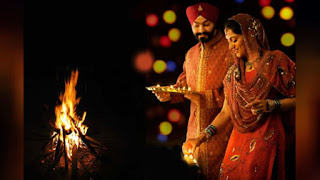
The various customs and traditions attached to the festival of Lohri signifies the harvesting of the Rabi crops. The people of Northern India, especially Punjab and Haryana celebrate Lohri, to mark the end of winter. Harvested fields and front yards are litup with flames of bonfires, around which people gather to meet friends and relatives and sing folk songs. For Punjabis,

In the morning, children go from door to door singing songs in praise of Dulha Bhatti, a Punjabi version of Robin Hood who robbed from the rich and helped the poor. These visitors are usually given money as they knock on their neighbor’s doors. In the evening, people gather around bonfires, throw sweets, puffed rice, and popcorn into the flames, sing popular folk songs and exchange greetings.

The Bonfire Customs & Tradition

In the evening, with the setting of the sun, huge bonfires are lit in the harvested fields and in the front yards of houses and people gather around the rising flames, circle around (parikrama) the bonfire and throw puffed rice, popcorn and other munchies into the fire, shouting "Aadar aye dilather jaye" (May honor come and poverty vanish!), and sing popular folk songs. This is a sort of prayer to Agni, the fire god, to bless the land with abundance and prosperity.

After the parikrama, people meet friends and relatives, exchange greetings and gifts, and distribute prasad (offerings made to god). The prasad comprises five main items: til, gajak, jaggery, peanuts, and popcorn. Winter savories are served around the bonfire with the traditional dinner of makki-ki-roti (multi-millet hand-rolled bread) and sarson-ka-saag (cooked mustard herbs).

On the Lohri day everyone gets into their best clothes and is festive. Gifts of sweets are exchanged. The courtyard and rooms of the house are swept and sprinkled with water. As the sun sets, all people dress up in their best and gather around the bonfire. Newly wed ones wear jewelery. The new-born are given little combs to hold. The a burning fagot is brought from the hearth and sets the Lohri bonfire alight. As the flames leap up, the girls throw sesame seed in them and bow. Someone sings:


“Let purity come, dirt depart
Dirt be uprooted and its roots Cast in the fire.”
People throw sticks of sugarcane into the fire and an aroma of burning sugar spreads in the atmosphere. Girls light fireworks and sparklers. The fire's glow lights faces with a golden hue. People sing and dance till the early hours of the morning, and little children sleep in their mother's laps.

When people throw sesame seeds in the fire they ask for sons. The saying is: As many as the elder brother's wife throws, so many sons the younger brother's wife will bear. That is why in homes where there is a new-born son or a newly wed man, Lohri is celebrated with even greater enthusiasm, and sweets made of molasses and sesame seed are sent to relatives and friends. Since the Punjabi word for sesame seed is til and for molasses rorhi the festival is also called Tilori.

Lohri is also an occasion when parents give presents to their newly married daughters. "For peasants, Lohri marks the beginning of a new financial year because on this day they settle the division of the products of the land between themselves and the tillers.
this is more than just a festival; it is also an example of their love for celebrations. Lohri celebrates fertility and the joy of life. People gather around bonfires, throw sweets, puffed rice and popcorn into the flames, sing popular and folksongs and exchange greetings.

Coconut Shell, Fibre & Stem Craft
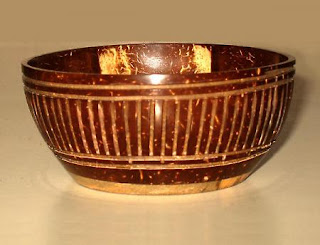
Coconut trees grow all over Kerala, and the coconut is a fruit which is used in its entirety. From the coconut shell products like bowls, vases, tea pots and hookas are crafted. Lamp stands encased in brass and smaller coconut shell articles are also made in Trivandrum, Attingal and Neyyatinkara, while larger items are made in Quilandy in Kozhikode district in north Kerala. Often hookas and large vases are also made by combining coconut shells with brass bindings. Coconut fibre is cleaned, smoothened and made into various dolls and toys with beads and coloured threads to it go give it a decorative appearance.
The process followed by the artisan to make a cup, for instance, is to rub the outer surface of the shell with steel wool and then smoothen the inner part with a chisel. A circular base and handle made with shell are attached to the cup with screws. The first coat of polish is boot polish, after which a final coat of French polish is give
Coconut Shell
Coconut Shell


This is a versatile craft and the articles made out of coconut shells range from table lamps and finger bowls to boxes and even jewellery. Basketry and mat-weaving are traditional crafts of the Nicorbarese and are usually done by the women in their leisure time. Mats are made from coconut stems and pandanus leaves and are used for sitting, sleeping, and making the walls of huts. Very often light and dark leaves are interwoven to create intricate patterns. The mats are soft, light, and cool, and have a glossy surface.

Bone and Shell
Bone and Shell
Marine mollusks(animals) strip off their calcareous casing from time to time. These are sea shells which are painted, etched, carved, cut and sculpted to form various utility and decorative handicraft items. Some of the shells used are puka, nautilus, mother of pearl(mop), blacklip, brownlip, hammer, troca, paua etc. Sea shells have been used by mankind since the stone age. They not only adorned their jewelry but also their boats and other belongings. Soon shells became an important part of their life. Some tribes even used shells as money. Among the Greeks and Romans, shells were a symbol of prosperity. Collecting and decorating with shells became a hobby for the aristocrats. Shells are used to make decorative tiles & floorings, walls, pots, picture frame & mirrors, jewelry boxes, lamp shades, ash trays, incense stick and candle stand and jewelry.

Tortoise Shell Craft
The main centre for the tortoise shell crafting is in Andhra Pradesh district of Vishakapatnam where chiefly trinket boxes are made in combination with bone. The shell surface of the box is covered with intricate designs of bone fretwork so that the orange glow of the shell can be seen through this perforated lacy pattern. The designs include fine geometrical patterns, epic figures and animals fringed by floral motifs.
A combination of horns, bone and tortoise shells are also combined to make products at Vishakapatnam and Secunderabad. Bone is also combined with sandalwood, ebony and tortoise shells to create intricate patterns of fretwork that are mounted or inlaid to make ornate octagonal jewel boxes with the bone net cover.

Shell Craft of Andaman & Nicobar

The large and beautiful shells found in abundance in the Andaman and Nicobar Islands. are cleaned and polished before being used to make ashtrays, small boxes, bangles, table lamps, and jewellery. An interesting and beautiful resource is the tortoise shell which is often inlaid with silver, and used to make jewellery and decorative artefacts such as rings and crosses to be worn around the neck. Shell, because of its light colour and luminous properties, is also being used for inlay work.
Bone has been used by human beings from the very beginning. Probably the bones left after decay of the animals was discovered by man. He might have used it as a weapon for hunting and defending himself. Subsequently it was put to various uses by carvers when not only utility but decorative objects of art were made. Captive jewelry, beads, combs etc are made from bones.


Jute Craft

The subtropical region of Asia, specially India, Bangladesh and China is most popular for Jute. Jute craft is most popular in this region and is derived from the fibre of a reed like plant. The warm humid climate of West Bengal with plenty of rainfall is best suited for this plant. The plant grows to a height of 3-4 meters and takes upto six months to mature. Jute is the second most popular natural plant fibre and is available in abundance.
Once the plant is ready for harvesting, it is cut very close to the ground and left in the ground for a day or two when the leaves fall off. The cut plant is then absorbed and dipped in water to separate the fibre from the plant. This process is known as retting. The, thus separated Jute is dried and given various forms. The fiber is knit into threads. Sometimes the threads are weaved to make rags and cloths. The cleaned fibre, the threads and the rags all are used to make beautiful craft products like the bags, rags, carpets, hangings, footwear, coasters, jewelry, show pieces, etc. Some very fine quality jute is also used to make furnishing material and dresses.

Products Available : Jute Jewelry( Jute Earings, Jute Necklaces, Jute Pendants), Jute Wine Bags, Jute Carry Bags, Jute Coasters


Clay & Terracotta

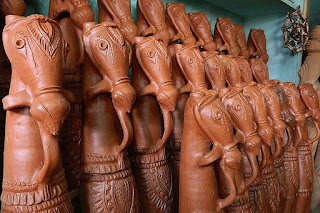
Clay figures are made all over Tamil Nadu and Pondicherry. Traditionally each village is guarded at its entrance by an enormous terracotta horse, which is the horse of Ayyanaar, a religious figure, the gramdevta of the village and its protector against all evils. Aiyyanar has an enormous moustache, big teeth and wide open eyes that keep constant vigil. Ayyanaar stands at the entrance surrounded by his horses and commanders or veerans.

Ayyanaar figures, which include the horses in the army, range in height from less than a metre to over 6 metres. They are some of the largest terracotta figures to be sculpted and are painstakingly made by mixing the moist clay with straw and sand for a proper consistency. For the horse, four clay cylinders are rolled out with a piece of wood, for the legs, after which the body is built up gradually. The accessories, such as bells, mirrors, grotesque faces (kirthimukha) and crocodiles (makaras), are made separately as is the head. The parts are joined together on the auspicious tenth day, when the figure of Ayyanaar seated on the horse is given its features. This is then baked in a rustic kiln of straw and verati or dried cow-dung which is then covered with mud. Parts of the larger figures have to be fired separately, joined together and fired again. The faces are sometimes painted red to denote anger and the neck blue to denote calm. The rest of the body and decorations are also painted in bright colours.

The oldest Ayyanaars and horses are found in Salem district. Salem and Pudukottai districts make the most large terracotta horses";" the smaller figures, human, divine and animal, are made all over the state. Given the time taken by the firing process, moulds are becoming popular to hasten the process. Ayyanaar figures are found in the village sanctuaries of Chettampatti and Nallur (Tiruchirapalli district), Tirripuyanam (Madurai district), and Vadugapalayam (Coimbatore district).

Most of the other village deities are also made of terracotta. The temples found in the village are usually for the mother goddess or ammankovil along with a temple to the deity Ganesha or Pillaiyaar.

Another important terracotta shrine is the naaga or serpent shrine, situated under a pipal tree near an anthill. It is made of clay with an intertwined body and is worshipped for its power of protection and rejuvenation. On Vinayaka Chathurthi clay Ganeshas are made and sold everywhere. These range in height from a few centimetres to a metre and they are glazed, painted, baked or often unbaked. The models are immersed in wells after the festival, and the unbaked form is preferred as it crumbles easily.

Other products crafted include water drawing and storing pots and cooking vessels. During the harvest festival of Pongal old pots in the house are replaced by new cooking pots, vessels for storing grain and a new container for the auspicious tulasi/holy basil plant. The pots symbolise continuity of life, creation, destruction and rebirth.

In Tamil Nadu, potters are known as kuyavar, kulalaar or velar and they trace their origin to Vishwakarma, the divine craftsman himself.

Some of them are in filigreed, fretted marble or sandstone. Some of the popular places of stone carvings are Meenakshi and Rameshwaram Temple of Tamil Nadu, Tirupati and Gundala Mallikarjuna Swami Temple of Andhra Pradesh and Cave and Vithala Temple of Karnataka. Bidri is a particular metal handicraft done in Andhra Pradesh. A particular type of mud from Bidar is used in oxidizing and therefore it is called Bidri. Bidri artwork designs have comprised different patterns over the centuries including stars. Plants, Animals, Flowers and other patterns that are typically contained within cautiously arranged balanced geometric fields.
Pottery is another form of craft, which is more or less practiced in all south Indian states. Pottery from Karukurichi in Tirunelveli district is noted for its attractive shapes and technical superiority. The base colors for the pottery of Tamil Nadu are red, black and grey colour. A glossier finish is given after a coating of red ochre. Khanapur in Belgaum district of Karnataka is famous for making large sized containers and jars because of the availability of a local clay.

Embroidery is also very much a part of the South Indians. In Tanjore in Tamil Nadu a different style of applique work is done for decoration on temple hangings. Andhra Pradesh is famous for bead embroidery, which is done on fine fabrics to adorn them. It is usually done on sarees and blouse pieces. Jangaon is famous for this type of work. White and colored beads are used on dark and bright bases. Karnataka is famous for kasuti embroidery. It is done with two types of stitches and the embroidery has a soft feminine angle.
Stone Carving
Stone Carving

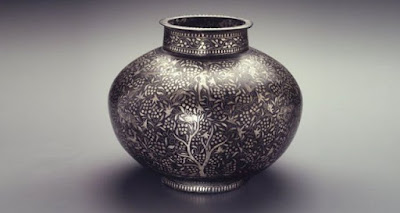
Winding through the cobble-stoned lanes of Bidar, 75 miles north-west of Hyderabad, one is impressed by the wealth of traditional and colorful artifacts that festoon the once rich township of Bahmani and Baridi dynasties. Amidst the embers of this famous historic settlement flourishes the conspicuously striking handicraft of Bidriware, splendid in beauty and design and scintillating in exquisite craftsmanship.
Bidriware


Another popular tale recounts that one of the Hindu kings of Bidar innovated the crafts of bidriware, using the articles thus decorated to hold flowers and other offerings in honor of his household Gods. Later, under the patronage of the Mughals, indigenous manufacturers were extended both co-operation and encouragement and in course of time, bidriwork reached its zenith in perfection, design and finesse.

The traditional art of damascening in silver or Koftgari work, as Bidri is popularly known, entails encrusting one field.

metal into another in the form of a wire. It is akin to the ancient art of inlaying gold and silver in copper and steel, which was practiced in Persia and Arabia at one time. It is believed that the know-how was brought to India from these countries but took an altogether different form, which became the specialty of Bidar from where it derives its name.

Process of making Bidriware

The origin of the technical aspect of bidriware is not definitely known. It appears that like other Persian articles of metal, this particular type of work was probably developed by experimenting with various alloys to guarantee brilliance by contrast. The resultant ingredient was an alloy of zinc and copper combined with other non-ferrous metals.

The new alloy, thus produced, is brittle but does not rust or corrode and has the additional advantage of allowing a better polish. Each bidri utensil has to pass through a long complicated process of casting, polishing, engraving, inlaying and blackening of the alloy before the final product is ready for the market.
Casting
The casting is done in moulds of red clay, a mixture of wax and resin covering the mould with a coating of red clay superimposed on it. This whole process is supported by stops, which may not be necessary in case of smaller articles. The product is then roughly polished on a lathe.
Bidriware


Making a Design
The design is first drawn freehand and later engraved with a sharp chisel in varying depths. Silver wire or pieces of the sheets are then embedded on the chased patterns by hammering. The highly intricate designs are however introduced at the time of the crafting itself.

A combination of chemicals varying from common salt, saltpeter, copper sulphate and salammonac when applied to the surface of the vessel transforms the color of the metal to jet-black. The final polishing with sandpaper, charcoal and coconut sets the shimmering silver in sharp relief to its satiny black background.

Bidri work boasts of versatility, design originality and fine craftsmanship. Gold inlay work is now rare but was at one time as popular as silver. At present, only silver is used to make the craft more vibrant.

Variations in Bidri Work
Slight variations in Bidri craftsmanship are the Taikashi or the brass metal wire inlay work, the Taihnishan and the Zamisshan in which the design is deeply cut and the Zar Buland which resembles the encrusted ware of Tanjore, where white designs are cut on the red and yellow ground of copper or brass vessels.

Another type of ornamentation is the Aftabi and Mumabatkari in which the patterns are wrought at slightly raised levels over the surface of the vessel, to look overlaid. Often, more than one style is used on the same article though a combination of Taikashi and Taihnishan is more common.

Mainpuri in Uttar Pradesh was once the stronghold of Taikashi decorations, where it was commonly engraved on wooden footwear. Nowadays, Taikashi work is more appreciated as part of furniture ornamentation especially in places like Jaipur and Delhi.
The Craft Practiced in other Places
The craft of Bidri is practiced in other places also like Purnia in Bihar, Lucknow in Uttar Pradesh and Murshidabad in West Bengal. The designs are mostly conventional ranging from creepers, flowers and sometimes human figures.

In the crowded marketplace of Murshidabad, one can see stalls filled with elegant flower vases, tumblers, plates, trays, cups, saucers in vivid bidri designs typical of the polished ware of Bidar.

In Bellori, a village four miles from the civil station of Purnia, one finds the local craftsmen, the Kansaris, busily engaged in molding and turning bidri vessels. The work of engraving and polishing is undertaken by the skilled sonar (goldsmith). Here, a popular variant of bidri is the gharki, in which the patterns are plain and inferior both in beauty and adroitness.

The local customs are so deeply entrenched in the minds of people that bidri art has never really been allowed to die. To cite an instance, at the time of the marriage of a girl, it is a custom in Hyderabad to present a complete set of bidri utensils to the bridegroom.

A modification of bidriwork can be seen in Lucknow's Zar Buland, where the ornamental designs are raised above the surface. Sometimes, gilt silver is used to cover the patterns. Large, delicate designs in silver in the form of flowers, leaves and even fish are encrusted all over the base metal.

Fish Emblem
The fish emblem can be traced back to the kings of Oudh, who delighted in parading their 'dignity of fish', Mahi Muratib, in the vanguard of all state processions.

The fish motto later became a noble design in art and architecture and bidri manufacturers adopted it as a natural culmination of bidri craft.

Traditionally, the nobles used hookah of various sizes and diverse shapes and designs varying from that of a ball, bell, cone, coconut or fruits like mangoes. The aftaba or the water jugs, and the sailabchi or the washbasins were at one time very popular both in the ladies' and the gentlemen's living room. Womenfolk from noble families particularly favored, dibyas,(cosmetic boxes), pandaans, and elaichi-daans, boxes for offering paan and supari, in quaint rectangular, oval, round, square, fish or leaf shapes. In households, weights known as the mir-e-farsh were used to keep the bed-sheets unruffled. These were often in enchanting aftabi workmanship with exotic lotus designs on them.

The Medieval Times
It is believed that the earliest craftsmen turning out bidriware probably migrated from Iran and were patronized by the Deccan rulers from the 15th century onwards. The bidri technique was usually handed down from generation to generation, and in the course of time local Muslims and Hindus of the Lingayat sect took to the trade.

Highly conventionalized patterns such as the Asharfi-ki-booti, stars, vine creepers and stylized poppy plants with flowers, the Persian Rose and bowls with passages from the Quran in Arabic script were in vogue.

Bidriware Today
The Salarjung Museum in Hyderabad has in its collection a beautiful farshi hookah designed in the Zar Buland technique with numerous lion's heads. Circular flowers with five petals in between decorative creepers are a mixture of Persian and European influence. Some of the other antique pieces are on display at the National Museum New Delhi, Hyderabad Museum and the Prince of Wales Museum, Mumbai.

With the passage of time, bidri articles changed their shapes and decorative motifs. Cigar boxes, cigarette cases, ashtrays, cuff links, matchbox covers, fruit bowls and other necessities of daily use began to find favor with the purchaser. A careful combination of old Persian motifs together with designs adopted from the Bidar Fort, Ajanta frescoes and Persian florals, typify modern day bidriware.

Bidri is yet another proof of the sea like character of Indian art and craft to absorb and assimilate the latest in craftsmanship in keeping pace with the developments in this extraordinary

Marble Handicraft
Whether you are decorating your home and office or looking for traditional and attractive gifts collection, we have some unique collections in marble handicrafts of your interest. These decorative marble handicraft items can create a unique and traditional look to your house and it will stand out for its grace and beauty.

Marble painting: Here you can find exotic range of handmade marble painting on real marble. Embossed and golden foil worked marble painting is available in beautifully carved figures including art, god painting, animals painting, birds painting, lady designed painting, instrumental painting, village painting and many more. Marble paintings are adorned with Meenakari, embossed and kundan work. This type of marvelous handmade marble painting enhances the beauty of your interiors, allowing you decorate you working and living area.

Marble utility item: Many carved utility items are available here. Utility marble handicrafts in India for home and office use as well as for decoration purpose like marble mobile holder, pen holder, clock, wall clock, pillar clock, pooja thali, kumkum boxes, jewelry boxes, napkin holder, marble pot, key holder, tray, lamp, chowki, glass and many more. All these marble utility items decorated with colorful designs, embossed work, stones and beads work are made using high grade Makarana marbles.
Marble Handicraft

Contact Form

Name

Email *

Message *

Powered by Blogger.
Javascript DisablePlease Enable Javascript To See All Widget